English Literature · Middle School · Grades 6-8 · Essays/Writing
Common Core · AP
By GradingPal Team · July 4, 2026 · 7 min read
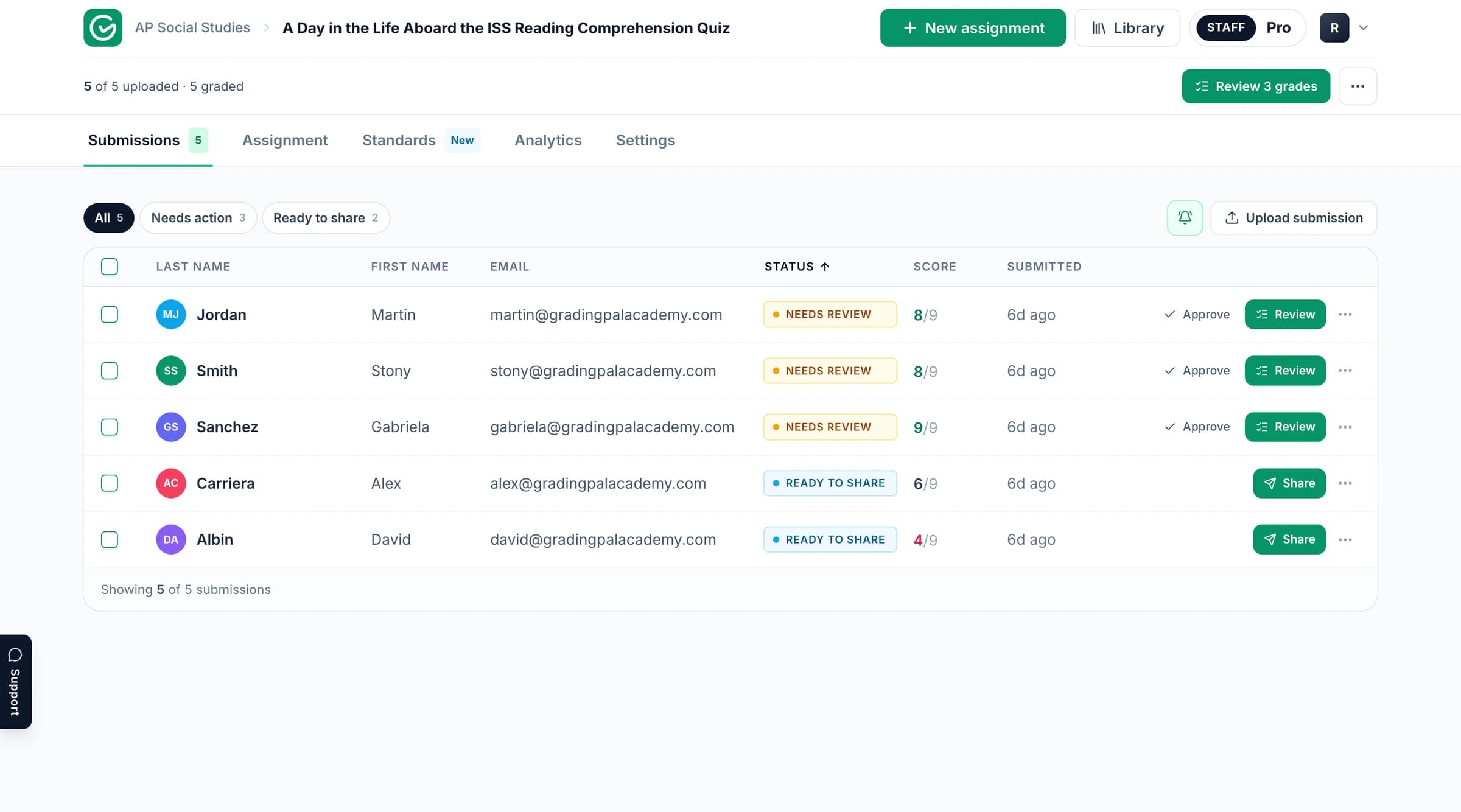
The GradingPal workspace. Product context; the published example and its media follow below.
Read the assignment and assessment example
Explore the original task and supporting material below. Follow the connection between the student’s response, the criteria being assessed, and the resulting assessment. The example provides its own context and evidence.
GradingPal is an AI grading assistant for teachers: upload student work and a rubric, and it drafts scores and specific, evidence-based feedback for you to review, edit, and release. In this use case, we'll follow a short literary analysis paragraph on Greek mythology, and watch a rubric reward genuine textual engagement over a quote that just happens to be present.
The problem
Close reading has several separate skills bundled inside what looks like one task: making a real claim, picking evidence that actually supports it, citing that evidence correctly, and then explaining in the student's own words why it matters. A student can nail three of those and stumble on the fourth, and a single holistic grade tends to blur exactly which one needs work.
It's also easy to reward surface compliance instead of real understanding. A quote is technically present, so the evidence box gets checked, without asking whether that quote is genuinely the right one, or whether the sentence after it actually explains the connection instead of just restating the quote in different words.
This is where GradingPal helps. It scores claim, evidence, citation, and explanation as separate skills against your rubric, and checks not just whether a quote is there, but whether it's the right one and whether the student actually explained it.
The assignment
The assignment: the Zeus character analysis paragraph
Assignment
This close-reading assignment asks students to analyze Zeus's attitude toward humanity using two paired texts, the myth of Prometheus and an excerpt from The Odyssey. Students choose between describing Zeus's attitude using details from Prometheus, or comparing which text better supports Zeus's or Prometheus's view of humans, using evidence from both. Either way, the paragraph needs a clear topic sentence, specific textual evidence, and the student's own explanation of how that evidence supports the claim.
It's a compact, single-paragraph task, written for a sixth-grade audience, but it's built around the exact same close-reading skills a full literary analysis essay demands at any grade level: a real claim, evidence that's actually chosen well, and an explanation that connects the two.
The rubric
The claim-evidence-explanation rubric inside GradingPal
Greek mythology rubric
The rubric breaks a six-point paragraph into five separate criteria: making a claim, providing evidence, citing that evidence correctly, explaining the evidence in the student's own words, and writing mechanics. Evidence itself requires two genuine direct quotations, not just one, and citation is checked against an exact modeled format, quotation marks, the author's last name, the correct paragraph number, and proper end punctuation.
Splitting evidence selection from evidence citation from evidence explanation is what makes this rubric work. A student can pick great evidence and still lose the citation point, or cite perfectly and still lose the explanation point for merely restating the quote. That's still your rubric, applied with that same precision to every student's paragraph.
The graded submissions
The teacher uploads the student's paragraph, and GradingPal scores each of the five criteria, checking the evidence directly against the source text.
The graded submission: numbered evidence spans and citation-level feedback
AI grading and feedback
Explanation and evidence for scores
Strengths & areas of growth
1 / 3
One paragraph scores 5 out of 6, earning full marks on the claim for restating the prompt, giving a direct answer, Zeus is controlling, and backing it with a specific reason. On evidence, GradingPal doesn't just count quotes, it locates and numbers each one directly in the student's own text, three in this case, exceeding the two-quote minimum, and confirms each one individually as genuinely relevant rather than padding.
The strengths feedback goes further than confirming a quote exists, it explains why this particular quote was a strong choice, showing the student carefully read the text to find evidence that specifically supports the claim about Zeus wanting to be served, and separately credits the explanation sentence that followed it for connecting the character's words to an inner personality trait, not just repeating them.
Where the point is lost, the feedback is exact: the author's name is spelled two different ways across the citations, Evslin in one place and Evillin in another, and a comma is misplaced before a closing quotation mark. Precise, fixable mechanics notes, not a vague deduction. Every score and comment stays editable before anything is released.
Classwide analytics
The class dashboard: comprehension versus citation mechanics
Classroom performance summary and trends
Strengths & areas of growth
Recommendation to address common challenges
1 / 3
Across the class, the AI-written summary draws a precise line: this class is much closer to analytical writing than to basic comprehension trouble. Students generally understood the texts, took a position, and chose relevant quotations, so the core reading-to-writing bridge is in place. What held many responses back wasn't having enough to say, it was not yet controlling the academic conventions that make evidence count as formal proof.
The numbers confirm it precisely. Nearly the whole class, 23 of 26 students, supported their ideas with at least two direct quotations, genuinely strong evidence selection. But 20 of 26 struggled with exact citation format, missing the author's last name, misplacing punctuation, or leaving out the paragraph number, the class's single biggest gap, and a clearly separate problem from evidence selection itself.
The recommendations scale to match. A whole-class mini-unit on citation and quote integration addresses the dominant gap, while much smaller, narrowly scoped small groups cover a specific comparison-prompt requirement some students missed entirely, sentence-level writing clinic needs, and, notably, a higher-order inference lesson for the few students who followed every rubric mechanic correctly but haven't yet learned to read between the lines of what a character's words reveal about their deeper motives.
The outcome
Here's what changes when a literary analysis response runs through GradingPal:
The teacher gets claim, evidence, citation, and explanation scored as four separate skills, so a low score always points at the specific piece that needs work, not a vague overall impression.
The student gets feedback that actually explains why their evidence choice worked: this quote was a strong pick because it directly supports your claim, now fix the citation format and you're there. Credit for real understanding, not just a quote's presence.
And the class gets a diagnosis that separates comprehension from citation mechanics, with a reteach plan scaled from a whole-class mini-unit down to a handful of students who need a genuinely higher-order inference lesson.
That's the point of close reading in the first place. We don't just want a quote in the paragraph. We want a real claim, evidence chosen with real judgment, cited correctly, and explained in the student's own words. GradingPal makes it practical to check for all four, whether the response is a single paragraph or a full essay.
Review the scoring and feedback with your task in mind
Start with what the learner was asked to demonstrate. Check the submitted work alongside the rubric expectations and any scoring explanation included in the example. Consider whether the feedback identifies a specific strength or a next action the student can take.
When you grade your own work in GradingPal, review the proposed scores and supporting evidence before approving them. For a calculation, inspect methods and intermediate steps as well as the answer. For an explanation, examine the relationship between the claim, evidence, and reasoning. Your rubric determines what earns credit.
Take the assessment further in GradingPal
GradingPal combines rubric scoring with individual feedback, standards mastery, and classroom analytics. These are product capabilities to explore for your own teaching; the published example above demonstrates the material contained in its original record.
Shape the feedback students receive
Choose Targeted, Glow & Grow, Structured, Sandwich, Actionable, or Socratic feedback. Set detail, supported language, and instructions for your teaching voice, then review the comments before sharing. Explore student feedback.
Track progress beyond one assignment
Approved, aligned evidence can contribute to a standards mastery record across assessments. Inspect the original work, choose among five calculation methods, and use teacher adjustments with a reason. Explore standards mastery.
Plan the next teaching step
Classroom analytics surface strengths, weaknesses, and recommended instructional next steps. Use the evidence to consider targeted practice, small-group support, or a class explanation. Explore analytics.
Reuse criteria across your team
Copy and edit a starting point from the 500-rubric catalog, or bring your existing rubric. Shared assignment and rubric libraries on eligible plans help colleagues reuse assessment resources. Explore the rubric library.
Explore more assessment examples
Continue with related published examples below or browse the full collection. GradingPal supports writing, math, science, handwritten work, worksheets, exams, slides, and supported recordings; the grader pages explain the wider product range.
See how GradingPal prepares rubric scores, explains the credit with evidence, and writes individual feedback for review. Start with 50 submissions per month on the free plan and check pricing for feature and format access.