GradingPal vs Gradescope: automatically score the working, then explain the next step
GradingPal reads handwritten math, science, and written responses and generates rubric-based scores with supporting evidence. It prepares individual feedback in your chosen style, tracks standards mastery, and surfaces what the class needs next. Get the first assessment done for you—and a complete system for using the results.
Published by GradingPal. Official competitor information reviewed on 9 September 2026.
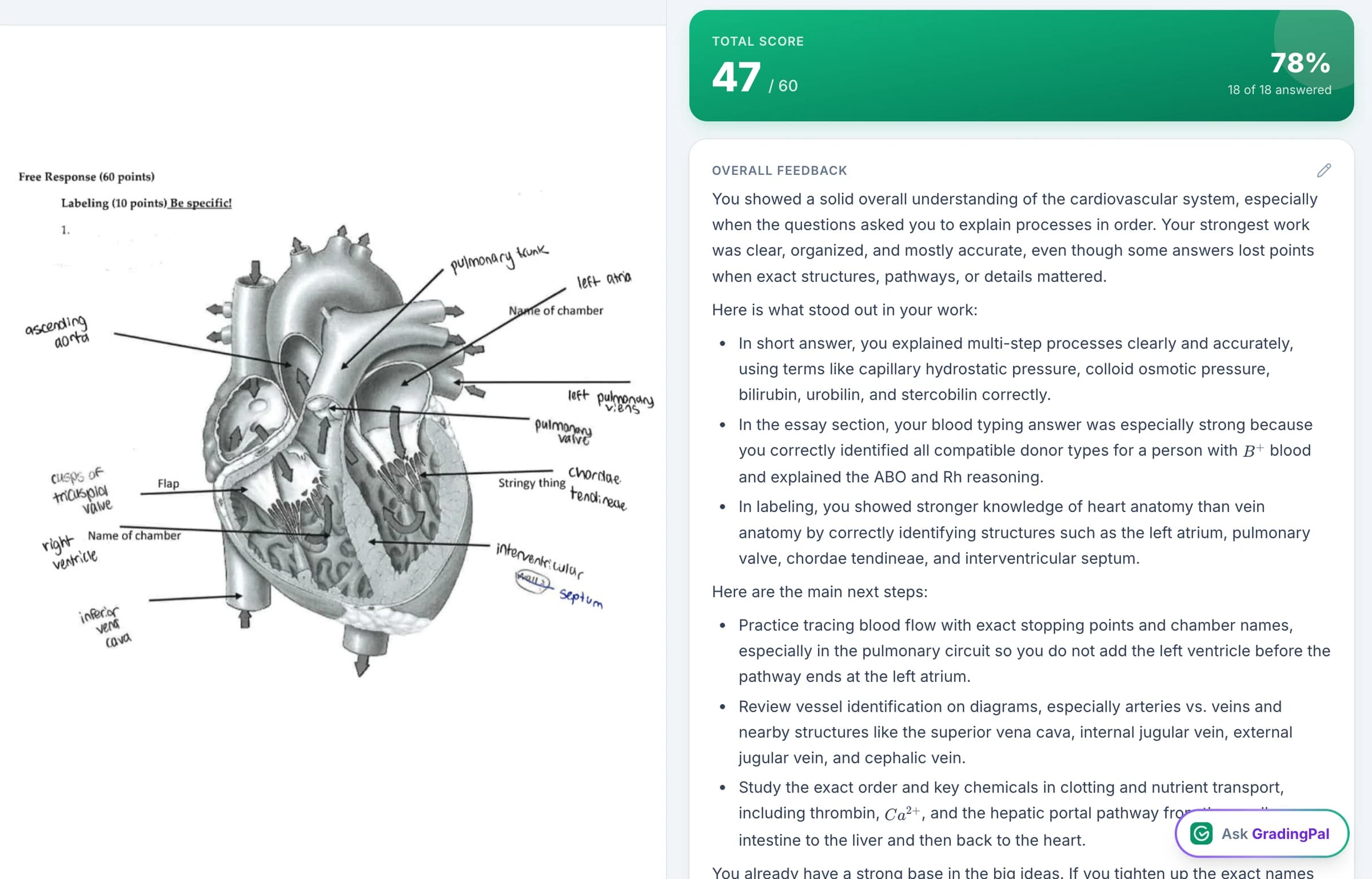
Choose GradingPal when you want the AI to produce the assessment
GradingPal generates the proposed rubric scores and student comments from the submitted work. You review the result, examine its evidence, and make the changes that need your judgment. That takes on the initial scoring and explanation work, as well as organizing the class set.
Gradescope's documented fixed-template answer-group workflow performs a different job: AI suggests groups, and instructors select rubric items to grade them. That distinction matters when your goal is to reduce the work of producing each assessment. Gradescope answer groups
Read the student's solution
Interpret supported handwriting, calculations, and explanations.
Assign the rubric score
Propose credit for the method, reasoning, and answer under your criteria.
Explain the judgment
Show the assessment evidence and reasoning for teacher review.
Prepare student feedback
Generate individual guidance in one of six feedback styles.
Follow learning
Use approved evidence in standards mastery and classroom insights.
Prepare the next assignment
Reuse a school rubric and respond to the learning gaps you found.
Gradescope also offers separate online answer-field autograding and programming autograders. The mechanism comparison here concerns its fixed-template answer groups, not all Gradescope assignment types.
Automatically grade handwritten methods and partial credit
Math assessment is about the working as well as the answer. GradingPal's AI math grader reads multi-step handwritten solutions and assesses them against your rubric. Define method marks, calculation credit, required answer forms, and partial-credit expectations.
The product gives you a proposed result and an explanation. You can distinguish the student who selected a sound method but made an arithmetic error from the student whose method needs revisiting. That distinction can then shape both the score and the student's next practice task.
Gradescope also recognizes handwriting and math notation in supported grouping types. The reason to choose GradingPal is what it does with the response: generate the rubric assessment and individual feedback for your review. Gradescope formatting guide
Grade science explanations, calculations, and mixed assessments
Use GradingPal for physics problems, chemistry calculations, biology explanations, and lab reports. Assess the model, the working, the use of data, and whether a conclusion follows from the evidence. A rubric can give each of those expectations its own place in the assessment. Explore science grading.
The same product handles short and long worksheet answers, essays, presentations, art, and recordings. A teaching team gets a common system for different kinds of submissions, while teachers retain subject-specific scoring criteria.
Check the score against the evidence, not just the total
GradingPal places the assessment in the context of the student's work. Review the rubric level, the reasoning behind it, and the relevant response together. See what earned credit and what the explanation says is missing.
That makes score verification practical. If the AI has interpreted a step incorrectly or the response warrants different credit, you can change the assessment with the evidence in view. This supports careful, accurate teacher review without requiring you to produce the entire first pass yourself.
What teachers say about GradingPal
“The math capabilities and accuracy have been great. Students can turn in homework digitally but keep hard copies for studying, and the Google Classroom integration is very convenient.”
 Brandon McClurgMathematics · Grapevine Faith Christian School, TX
“GradingPal has been incredible in helping me grade quicker and get better at feedback. The rubric creator creates great feedback without much change by me, and I’m able to get my students’ work back to them faster with actionable feedback.”
 William Pollard9th Grade · Earth & Space Science · NYC Dept. of Education District 15, Brooklyn NY
Give each student the kind of feedback the task needs
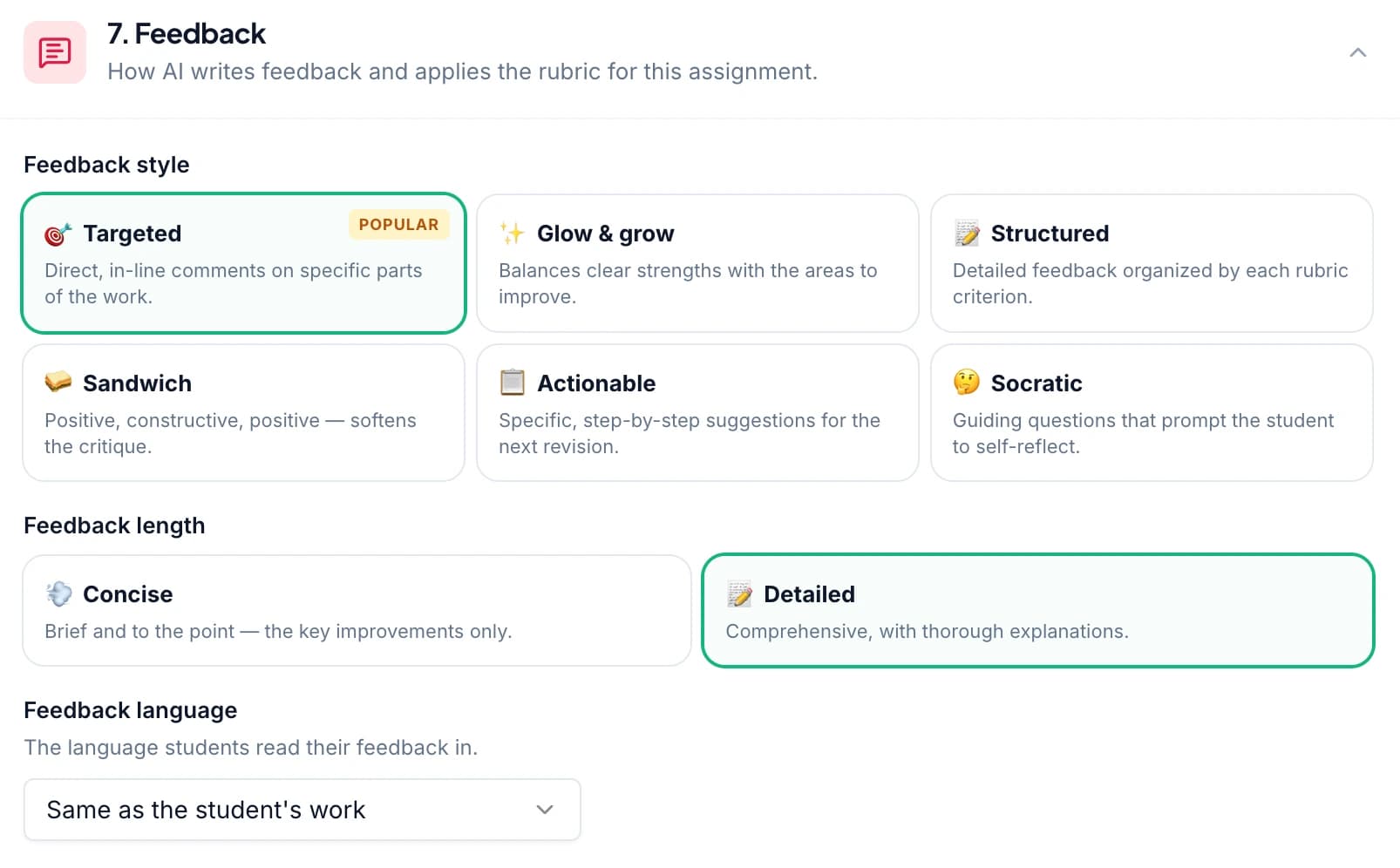
Two students can arrive at the same answer through different reasoning. GradingPal writes feedback about the individual response, then lets you choose how the guidance reaches the student.
Targeted
Back for a specific step.
Glow & Grow
A strength and an improvement.
Structured
Criterion-based explanation.
Sandwich
An encouraging development message.
Actionable
Revision steps.
Socratic
Questions that guide the student to the correction.
Set detail, language, and your own instructions as well. See all six styles.
For a formative problem set, a Socratic question can leave the reasoning with the student. For a completed exam, Structured feedback can explain where the credit was awarded. You choose the teaching purpose; GradingPal prepares the individual comments. Illustrative question: “Your first two steps preserve the equality. Does the third step apply the same operation to both sides?”
Track mastery across exams, practice, and reassessment
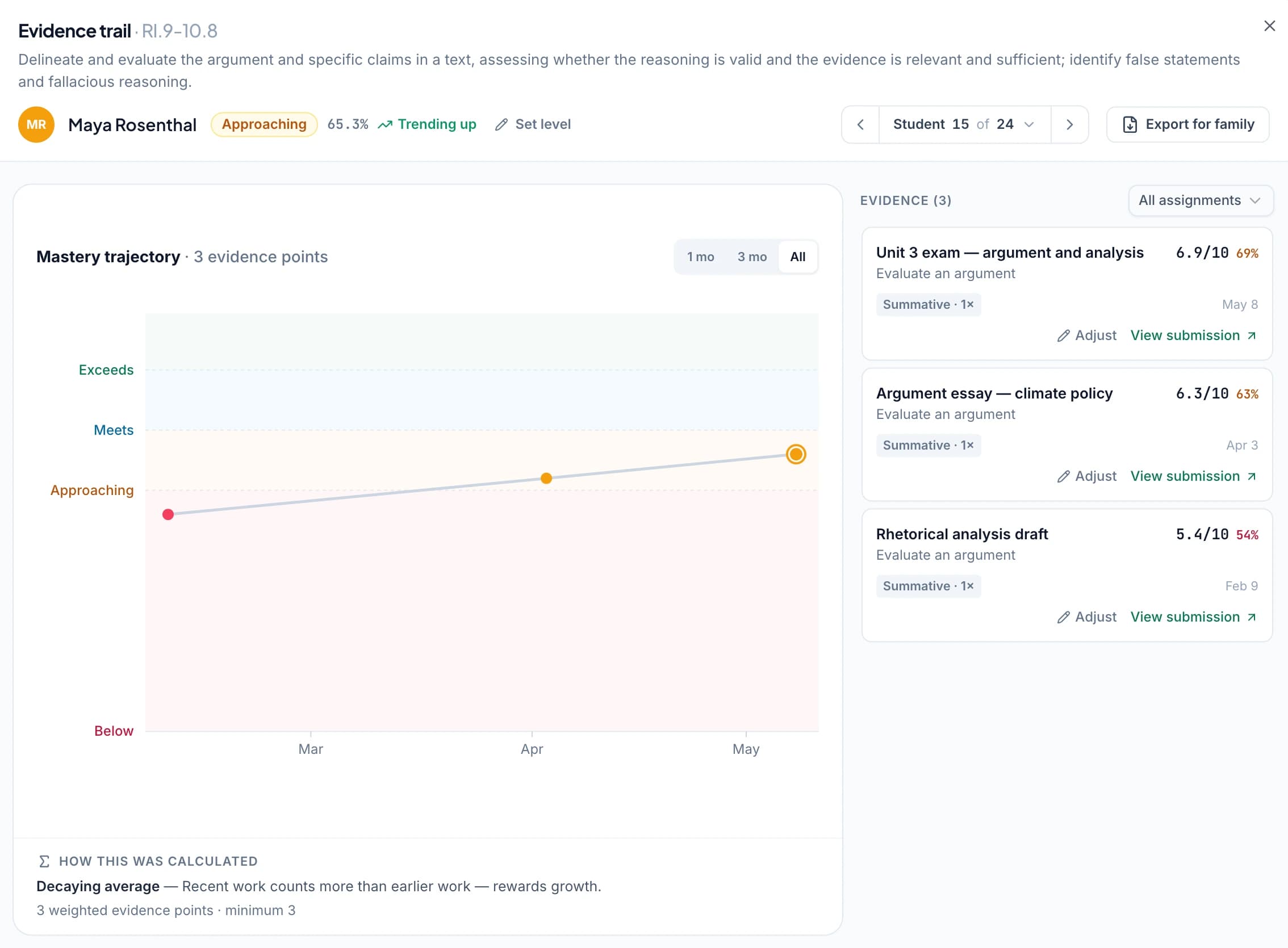
A single exam is one piece of evidence. GradingPal's standards mastery gradebook brings approved, aligned results together across assignments and shows the work behind each standard's record.
You control the calculation through simple average, decaying average, most recent attempts, most frequent level, or highest level. Set the role of practice, weight assessment categories, and choose a minimum evidence requirement. You can also adjust a student's level with a reason while keeping the calculated result and supporting work visible.
This gives a teacher a meaningful way to examine reassessment: what has the student now demonstrated, and how does it relate to earlier evidence? Use Common Core, NGSS, TEKS, and relevant AP and IB course/rubric resources. The standards directory covers all 50 states and Washington, DC.
Turn the class set into a focused reteaching plan
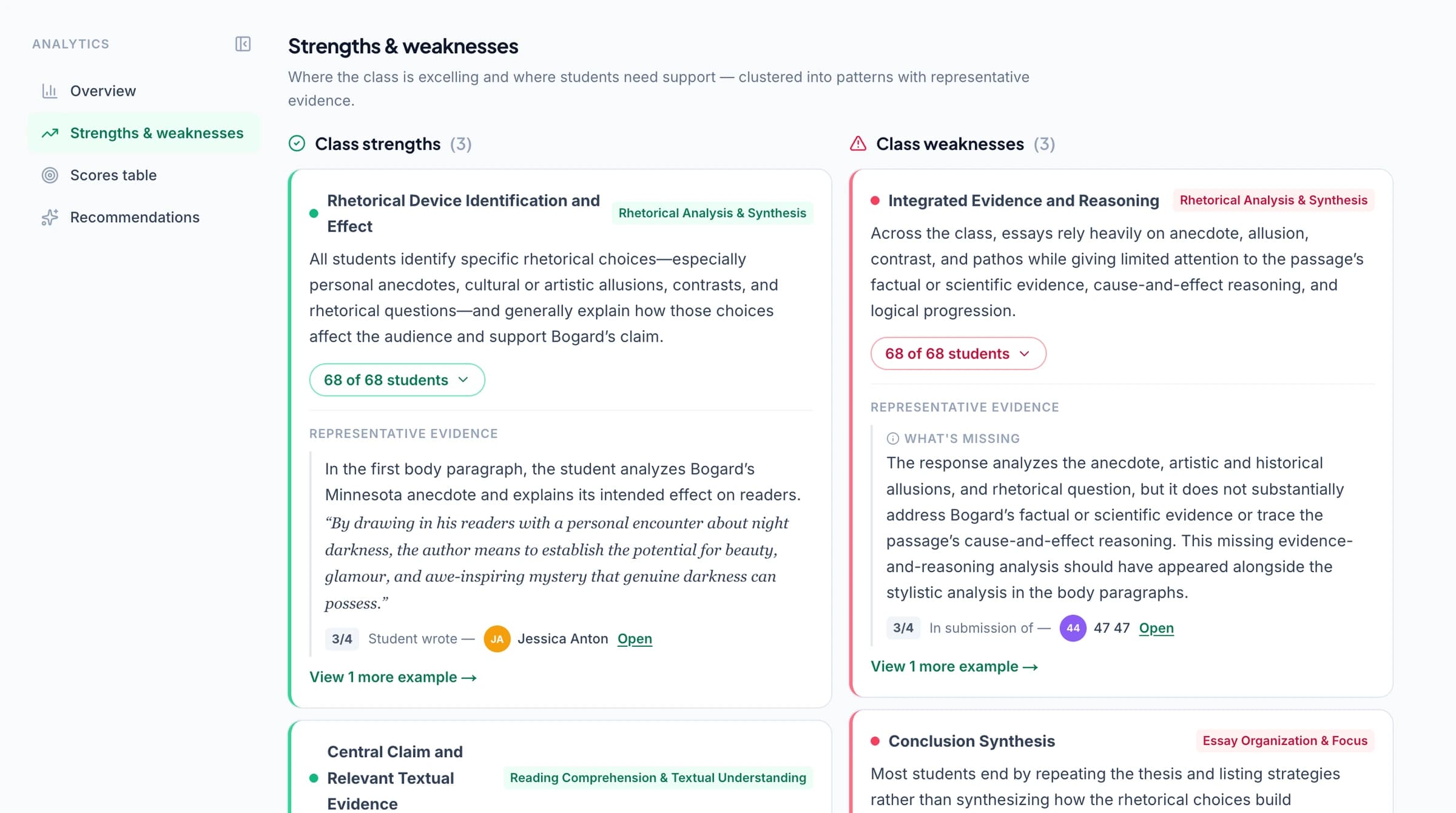
Classroom analytics surface common strengths and weaknesses and suggest instructional next steps. Identify whether the difficulty lies in choosing a method, carrying it out, interpreting data, or explaining a conclusion. Use that information to plan a worked example or targeted support.
Feedback gives the individual student a next step. Analytics give you the class pattern. Mastery tracking follows evidence across subsequent work. GradingPal puts all three to use after the initial scoring is complete.
Reuse school rubrics and refine them with the assistant
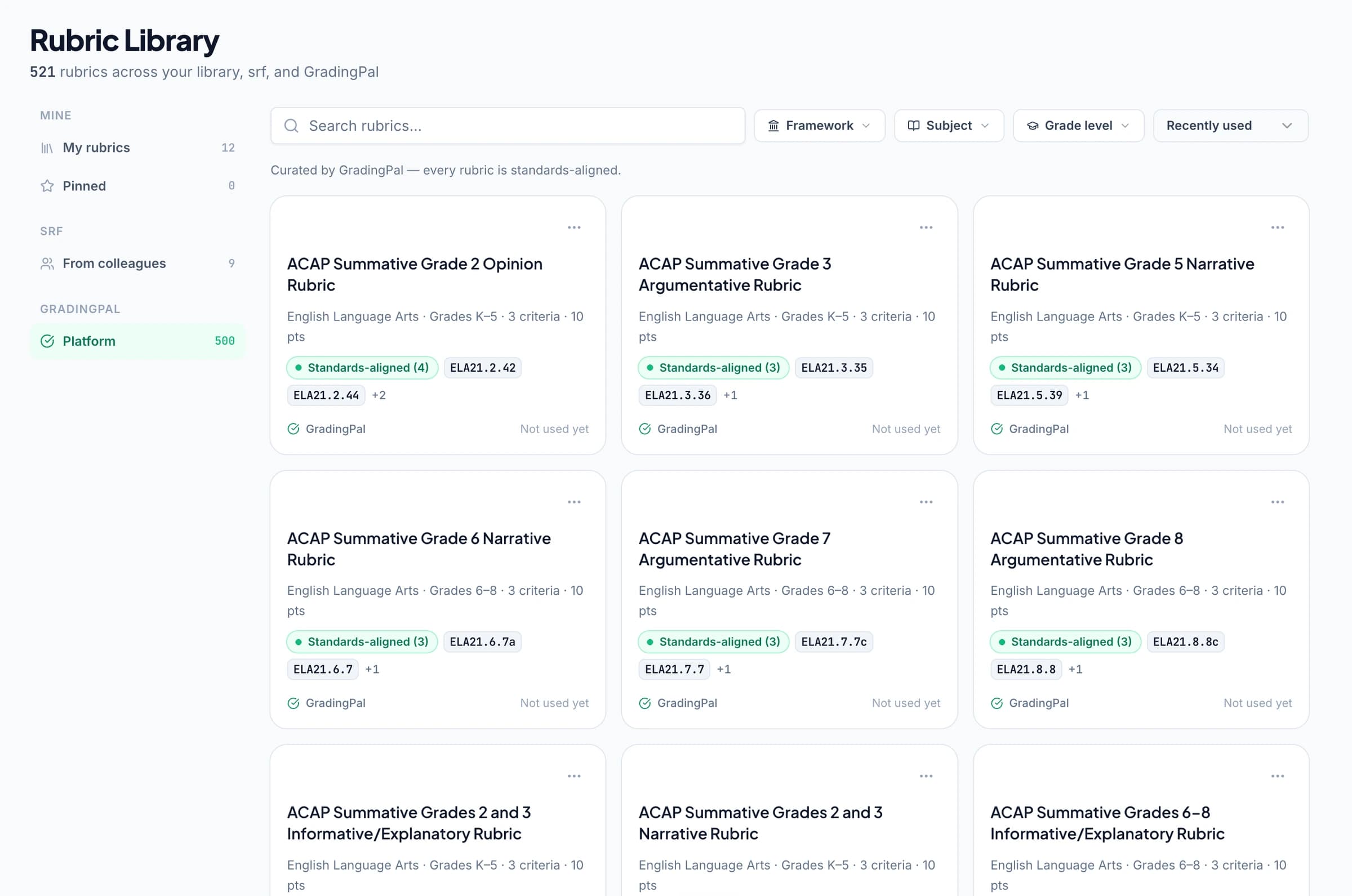
GradingPal's 500-rubric catalog and rubric library reduce the work of preparing criteria. Adapt a working copy, adjust levels and points, or bring your own mark scheme. On shared-library plans, colleagues can reuse assignment and rubric resources across the team.
Ask GradingPal can propose a criterion, score change, or feedback revision inside the assessment. Inspect the edit before accepting it, then print, share, or schedule feedback. The same product supports preparation, scoring, refinement, and the use of the results.
Fit the assessment system to your school
Google Classroom is available now. Canvas and Schoology are available on a school plan. Discuss shared resources, training, and feature access with the team, and review student-data protections.
See pricing and GradingPal for schools, or contact us. Gradescope's help center provides its current guidance for other workflows and integrations.



Questions about GradingPal and Gradescope
Why choose GradingPal for math and science grading?
GradingPal generates rubric scores, supporting explanations, and individual feedback from the work students submit. It then connects approved evidence to teaching insights and mastery tracking. Choose it to reduce the initial marking work and make the assessment useful after the grade is returned.
Is this a complete Gradescope feature or accuracy comparison?
No. The specific mechanism comparison concerns the cited answer-group workflow. Gradescope has other assignment types, including autograding capabilities. No matched accuracy result is presented here.
Can GradingPal assess handwritten exams?
Yes. Bring supported scans or photos and your rubric. GradingPal reads the work and prepares the scoring and feedback; you can check the source pages and explanation before returning the result.
How should I test the difference?
Use the same rubric and representative work, including a response deserving partial credit. Inspect the generated scores, evidence, corrections needed, and usefulness of the student feedback. A demo can also show the mastery and school-library features.
Can I choose how feedback is written?
Yes. GradingPal offers Targeted, Glow & Grow, Structured, Sandwich, Actionable, and Socratic feedback, with controls for length, language, and your own instructions. The communication can change while the rubric remains the basis for scoring.
Get the marking done—and more value from the results
Bring your next math, science, or written assignment to GradingPal. Review scores backed by evidence, return individual feedback, and use what you learn about the class to plan the next lesson.