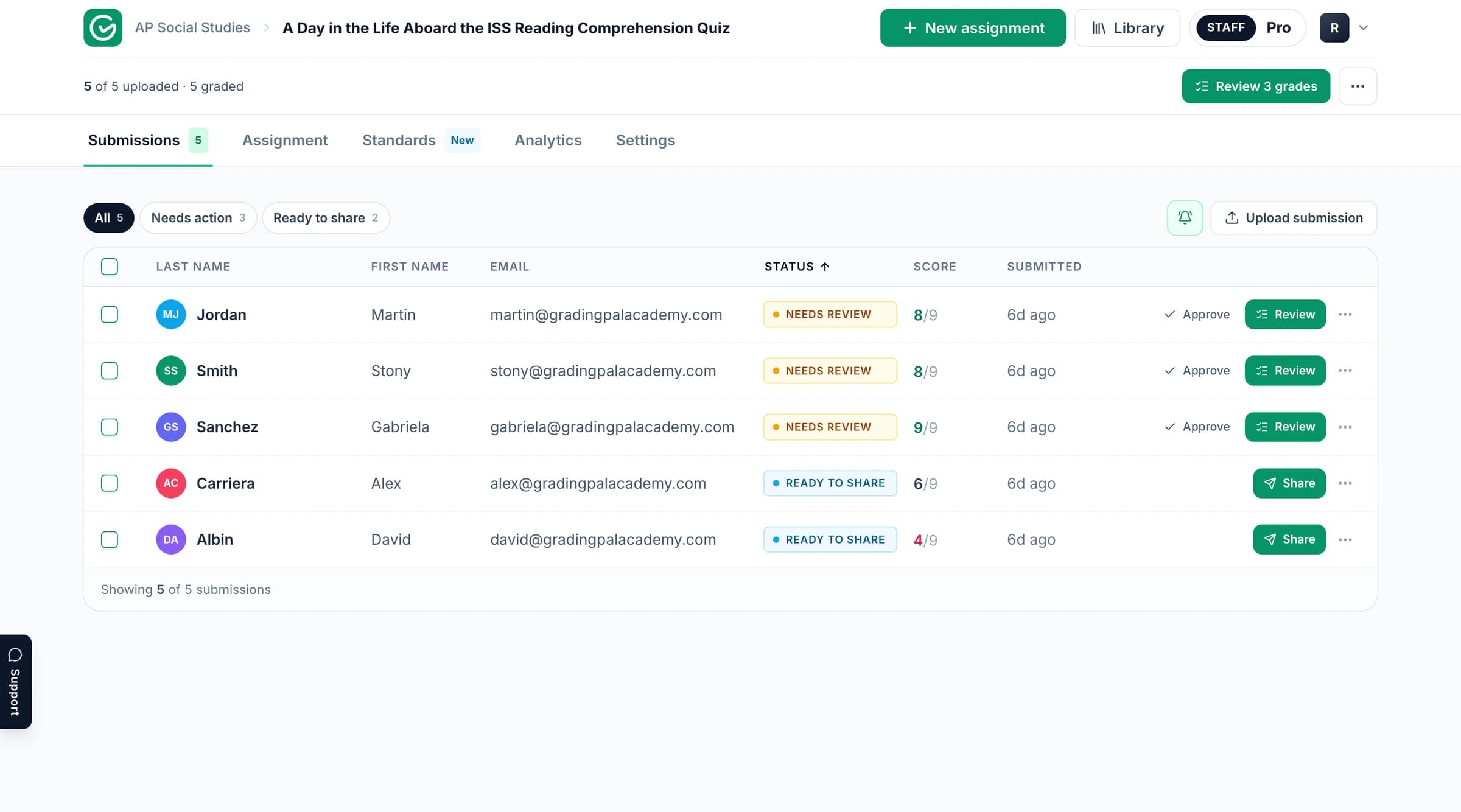
The GradingPal workspace. Product context; the published example and its media follow below.
Read the assignment and assessment example
Explore the original task and supporting material below. Follow the connection between the student’s response, the criteria being assessed, and the resulting assessment. The example provides its own context and evidence.
GradingPal is an AI grading assistant for teachers: upload student work and a rubric, and it drafts scores and specific, evidence-based feedback for you to review, edit, and release. In this use case, we'll follow a handwritten geometry worksheet on angles, parallel lines, and polygons, where the hardest part isn't the arithmetic, it's knowing which rule a given diagram actually calls for.
The problem
Geometry problems live inside their diagrams. A worked equation can be arithmetically flawless and still be wrong, because the student applied a triangle rule to a figure that's actually testing parallel lines, or read a straight-line angle relationship into a diagram that doesn't have one. Grading that well means reading the figure itself, not just the equation underneath it.
Some errors are even more specific to geometry than a wrong number. Naming a polygon's vertices out of cyclic order is wrong even when every letter used is correct, and that's the kind of precision a quick grading pass, scanning for the right shape name, tends to miss entirely.
This is where GradingPal helps. It reads the actual diagram alongside the student's work, checks it against your rubric, and can tell a correct answer from the wrong rule applied to the right numbers.
The assignment
The assignment: the angles, parallel lines, and polygons worksheet
Assignment part 1
Assignment part 2
1 / 2
This two-page geometry worksheet is built almost entirely around diagrams. Every question anchors to a hand-drawn figure, angles on a straight line, a transversal crossing parallel lines, an irregular pentagon, a complex multi-line intersection, and asks students to find an unknown angle, justify whether two lines are parallel, or name a polygon using its labeled vertices.
Some questions are multi-part, requiring two different geometric properties to solve two different unknowns in the same figure, and one is a genuine proof question, requiring named theorems to justify why two lines are not parallel. The worksheet itself is in Chinese, and GradingPal reads it and coaches the student in English, matching the way the class actually operates.
The rubric
The diagram-specific rubric inside GradingPal
Rubric part 1
Rubric part 2
Rubric part 3
Rubric part 4
1 / 4
Nearly every question gets its own rubric, and each one is written around that specific diagram, not a generic geometry standard. One rubric requires the exact equation for angles on a straight line and the target value it should produce. Another requires identifying alternate interior angles from a labeled parallel-line figure. A multi-part question gets split into two entirely separate rubrics, one per unknown, since each sub-answer depends on a different geometric property. The polygon-naming rubrics go further still, requiring vertices listed in continuous cyclic order, explicitly penalizing a technically-correct-letters-wrong-order answer.
That's still your rubric, decomposed down to the level of the individual diagram, applied consistently to every student's worksheet.
The graded submissions
The teacher uploads the scanned worksheet, and GradingPal reads each diagram and the student's handwritten work together, checking every question and sub-question against its matching rubric.
The graded submission: diagrams read alongside handwritten work
AI grading that reads handwriting
Strengths & weaknesses
1 / 2
One worksheet scores 19 out of 21, with feedback that confirms each step of the correct work individually: the right property identified for angles on a straight line, the equation set up correctly, and the correct value solved for. On a fully correct answer elsewhere, the feedback still pushes for more rigor, suggesting the student explicitly name why one angle matches another using the parallel lines in the figure, rather than stopping at the right number.
Where points are lost, the diagnosis names the actual error precisely: on one multi-part question, the feedback explains that the student treated a parallel-lines figure like a triangle-angle problem, picking the wrong rule for that diagram entirely, not just making an arithmetic slip. The overall feedback closes with a concrete strategy: when a diagram has several lines, label the known angle relationships on the figure itself before solving for the unknown.
Every score and comment stays editable before anything reaches the student.
Classwide analytics
The class dashboard: diagram interpretation and a triaged reteach plan
Classroom performance analytics
Common strengths & weaknesses
Recommendations to improve classroom-wide performance
1 / 3
Across the class, the mean sits at 65.5 percent, and the AI-written summary is specific about where the class actually struggles: students are secure with single-step routines when a diagram clearly points to one familiar rule, but performance drops once a more crowded figure requires choosing which rule governs it, or once the task shifts from computing a number to naming something with precision. The issue isn't basic angle facts, it's picking the right structure and attending to the exact language of the question.
The class's single biggest weakness is naming polygons with vertices in the correct cyclic order, affecting roughly 15 of 26 students, with the exact failure pattern shown, correct letters, wrong sequence. A smaller group loses track partway through a multi-step angle chase before reaching the final answer, a distinct and separately reteachable gap.
A dedicated recommendations list turns those findings into a ranked action plan, a whole-class reteach on identifying the governing structure in complex diagrams reaches the entire class, a small-group lesson on cyclic vertex naming reaches just over half, and two narrower small-group pull-outs address the multi-step chase and a specific misconception about matching angles without checking whether a conversion is actually required, each scoped to exactly the students it affects.
The outcome
Here's what changes when a geometry worksheet like this runs through GradingPal:
The teacher gets diagrams read and checked alongside the work, so a wrong answer caused by the wrong rule is diagnosed as exactly that, not just marked incorrect.
The student gets told exactly what went wrong: you treated this parallel-lines figure like a triangle problem, here's the rule this diagram actually calls for. That's a precise, fixable correction instead of a generic wrong-answer mark.
And the class gets a ranked reteach plan, whole-class where nearly everyone needs it, small-group where only a fraction does, built directly from what the diagrams actually revealed.
That's the point of a diagram-based geometry worksheet in the first place. We don't just want the right number. We want students to read a figure, choose the rule it actually calls for, and name what they see with precision. GradingPal makes it practical to check for all three, on every diagram, every time.
Review the scoring and feedback with your task in mind
Start with what the learner was asked to demonstrate. Check the submitted work alongside the rubric expectations and any scoring explanation included in the example. Consider whether the feedback identifies a specific strength or a next action the student can take.
When you grade your own work in GradingPal, review the proposed scores and supporting evidence before approving them. For a calculation, inspect methods and intermediate steps as well as the answer. For an explanation, examine the relationship between the claim, evidence, and reasoning. Your rubric determines what earns credit.
Take the assessment further in GradingPal
GradingPal combines rubric scoring with individual feedback, standards mastery, and classroom analytics. These are product capabilities to explore for your own teaching; the published example above demonstrates the material contained in its original record.
Shape the feedback students receive
Choose Targeted, Glow & Grow, Structured, Sandwich, Actionable, or Socratic feedback. Set detail, supported language, and instructions for your teaching voice, then review the comments before sharing. Explore student feedback.
Track progress beyond one assignment
Approved, aligned evidence can contribute to a standards mastery record across assessments. Inspect the original work, choose among five calculation methods, and use teacher adjustments with a reason. Explore standards mastery.
Plan the next teaching step
Classroom analytics surface strengths, weaknesses, and recommended instructional next steps. Use the evidence to consider targeted practice, small-group support, or a class explanation. Explore analytics.
Reuse criteria across your team
Copy and edit a starting point from the 500-rubric catalog, or bring your existing rubric. Shared assignment and rubric libraries on eligible plans help colleagues reuse assessment resources. Explore the rubric library.
Explore more assessment examples
Continue with related published examples below or browse the full collection. GradingPal supports writing, math, science, handwritten work, worksheets, exams, slides, and supported recordings; the grader pages explain the wider product range.
See how GradingPal prepares rubric scores, explains the credit with evidence, and writes individual feedback for review. Start with 50 submissions per month on the free plan and check pricing for feature and format access.