English / ELA · Elementary · Grades 3-5 · Essays/Writing
Common Core
By GradingPal Team · July 4, 2026 · 7 min read
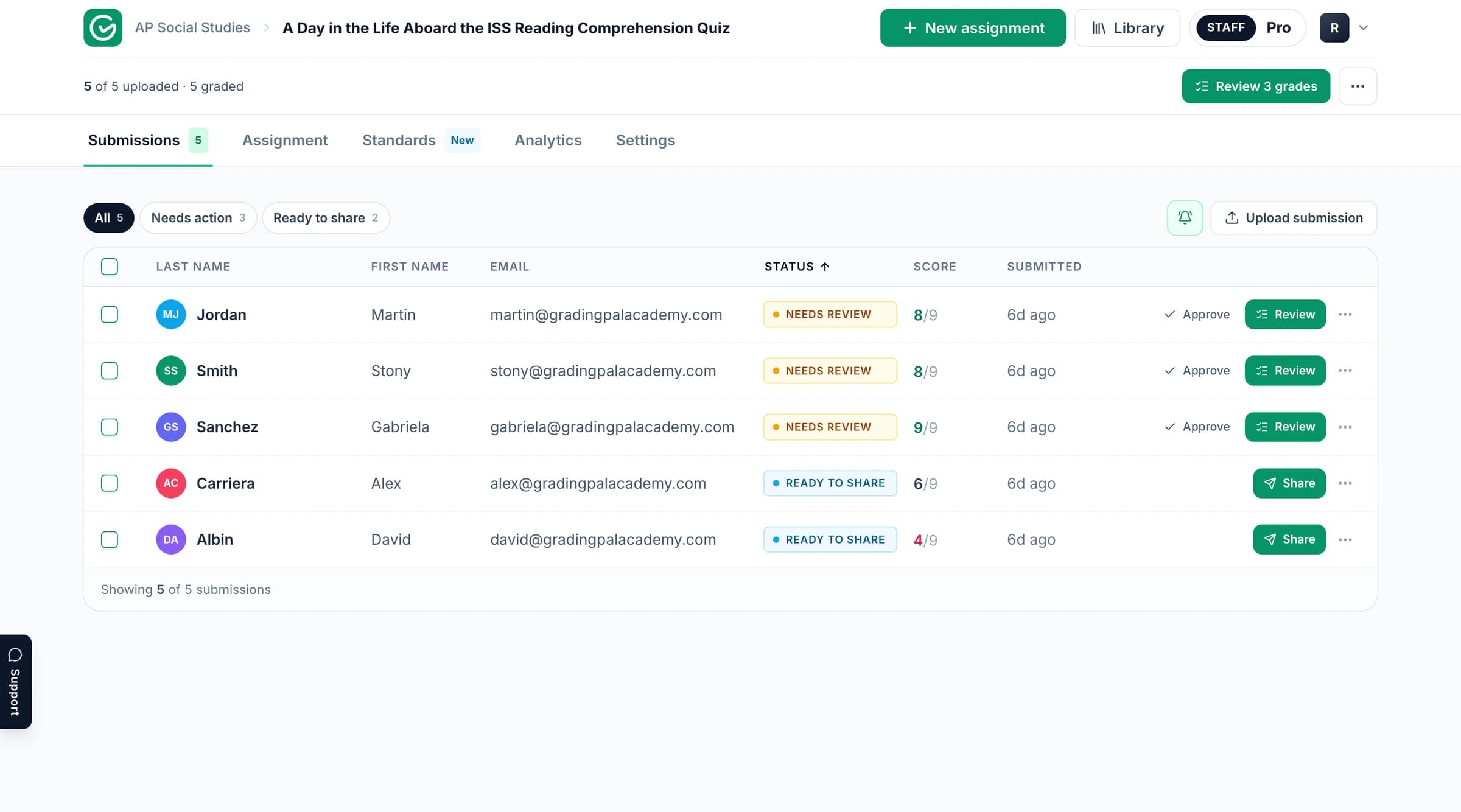
The GradingPal workspace. Product context; the published example and its media follow below.
Read the assignment and assessment example
Explore the original task and supporting material below. Follow the connection between the student’s response, the criteria being assessed, and the resulting assessment. The example provides its own context and evidence.
GradingPal is an AI grading assistant for teachers: upload student work and a rubric, and it drafts scores and specific, evidence-based feedback for you to review, edit, and release. In this use case, we'll follow a fourth grader's realistic fiction story and watch the feedback stay encouraging and craft-focused, exactly the tone a young writer actually needs to hear.
The problem
Creative writing feedback for a young writer has to do two things a strict correction pass usually doesn't: name the craft that's actually working, using real literary vocabulary a student can grow into, and frame the mistakes gently enough that a fourth grader stays motivated to revise instead of discouraged by red ink.
It's easy to default to one tone for every grade level, treating a run-on sentence in a nine-year-old's short story the same way you'd flag it in a college essay. That mismatch either scares off a developing writer or, just as often, undersells feedback that should be specific and craft-literate rather than a generic pat on the back.
This is where GradingPal helps. It grades against your narrative rubric, names specific craft moves by their real literary terms, and keeps the tone age-appropriate and growth-oriented throughout.
The assignment
This elementary assignment asks students to type up a realistic fiction story from an earlier planning packet. The requirements are craft-focused rather than academic: plenty of show-not-tell detail, quotation marks used correctly for dialogue, and strong, specific word choice throughout.
One sample story, The Mixed Christmas, follows a boy named Jake who mistakenly believes he didn't get presents. It's genuinely creative writing, dialogue, pacing, sensory description, not an essay or an analytical response, which makes it a different kind of grading task than most other writing assignments.
The rubric
The four-trait narrative rubric inside GradingPal
Narrative point rubric
The rubric covers four familiar narrative-writing traits worth 100 points: ideas and focus, organization, language, and delivery and conventions. Each one is scored on a clean five-level scale, with the top level spelling out exactly what strong elementary narrative writing looks like, a clear, developed arc; a logical, easy-to-follow sequence; precise sensory and figurative language; and correct grammar, spelling, and punctuation throughout.
It's still your rubric, and GradingPal can also fold in a teacher's own classroom vocabulary, the CUPS acronym for conventions, capitalization, usage, punctuation, spelling, applied directly in the feedback rather than substituted with generic grammar language.
The graded submissions
The teacher uploads the student's story, and GradingPal scores each trait, highlighting the exact sentences that earned credit.
The graded submission: highlighted craft moves and age-appropriate coaching
Scores and feedback generated by AI
Annotated evidence for score selection
Targeted feedback comments
1 / 3
The Mixed Christmas scores 88 out of 100, and the feedback identifies real craft by name: a strong sensory detail for touch, a strong example of showing emotion through physical description paired with an idiom, a genuine use of hyperbole and onomatopoeia. One comment calls out excellent use of onomatopoeia specifically, explaining that it helps the reader hear the action and makes the scene transition more engaging, praise a young writer can actually learn from because it names the exact technique.
Where the language score stays at Level 3 instead of Level 4, the reasoning is specific rather than a flat deduction: the writing leans on adverbs in dialogue tags, said sadly, yelled madly, instead of consistently showing emotion through action. The revision suggestion offers an actual rewritten alternative, replacing a repeated line about brushing teeth twice with a sensory detail like the minty sting of toothpaste, a concrete model instead of a vague note to add more description.
The tone stays calibrated throughout. A merged-word typo gets called a small typing error, not a mistake, and the note connects it gently to why proofreading helps dialogue flow smoothly for the reader. Every comment stays editable, and nothing reaches the student until the teacher releases it.
Classwide analytics
The class dashboard: creative capacity versus craft control
Classroom performance summary
Strengths & weaknesses
Recommendation to tackle common challenges
1 / 3
Across the class, the mean sits at 85 percent with a tight, consistent distribution, no student below 70. The AI-written summary is calibrated to exactly how an elementary writing teacher thinks about growth: this class has the core architecture of narrative writing in place, most students can tell a coherent story and are starting to use dialogue and descriptive moves with purpose. The limiter isn't idea generation, it's craft control, applying those moves consistently enough to sustain development, manage time shifts, and edit dialogue and conventions cleanly.
The criterion breakdown shows organization as the clear class strength at 94 percent, with delivery and conventions the relative weak point at 79. Eighteen of 24 students show frequent conventions errors, missing quotation marks, run-together dialogue, the class's biggest gap, while a smaller group of nine tends to tell feelings directly, Bella is mad and sad, rather than building emotion through action or sensory detail.
The recommendations scale accordingly. A whole-class mini-unit on dialogue punctuation and editing addresses the biggest shared gap, while three smaller small-group sessions cover building fuller scenes with sensory detail, turning telling into showing, and smoothing transitions between time jumps, each sized to exactly the students who need it.
The outcome
Here's what changes when a narrative writing piece runs through GradingPal:
The teacher gets craft-literate scoring on every story, real literary vocabulary applied consistently, with the tone calibrated to the age of the writer rather than a one-size-fits-all correction style.
The student gets feedback that names what's working and shows exactly how to fix what isn't: your onomatopoeia here was excellent, and here's how a sensory detail could replace that repeated line. Encouraging and specific at the same time.
And the class gets a plan that separates creative capacity from craft control, with a reteach scaled from a whole-class conventions unit down to the smaller groups still working on showing instead of telling.
That's the point of teaching creative writing at this age. We don't just want a finished story. We want students to build real craft, dialogue, sensory detail, pacing, and to stay motivated enough to keep revising. GradingPal makes it practical to give that kind of feedback on every story, every time.
Review the scoring and feedback with your task in mind
Start with what the learner was asked to demonstrate. Check the submitted work alongside the rubric expectations and any scoring explanation included in the example. Consider whether the feedback identifies a specific strength or a next action the student can take.
When you grade your own work in GradingPal, review the proposed scores and supporting evidence before approving them. For a calculation, inspect methods and intermediate steps as well as the answer. For an explanation, examine the relationship between the claim, evidence, and reasoning. Your rubric determines what earns credit.
Take the assessment further in GradingPal
GradingPal combines rubric scoring with individual feedback, standards mastery, and classroom analytics. These are product capabilities to explore for your own teaching; the published example above demonstrates the material contained in its original record.
Shape the feedback students receive
Choose Targeted, Glow & Grow, Structured, Sandwich, Actionable, or Socratic feedback. Set detail, supported language, and instructions for your teaching voice, then review the comments before sharing. Explore student feedback.
Track progress beyond one assignment
Approved, aligned evidence can contribute to a standards mastery record across assessments. Inspect the original work, choose among five calculation methods, and use teacher adjustments with a reason. Explore standards mastery.
Plan the next teaching step
Classroom analytics surface strengths, weaknesses, and recommended instructional next steps. Use the evidence to consider targeted practice, small-group support, or a class explanation. Explore analytics.
Reuse criteria across your team
Copy and edit a starting point from the 500-rubric catalog, or bring your existing rubric. Shared assignment and rubric libraries on eligible plans help colleagues reuse assessment resources. Explore the rubric library.
Explore more assessment examples
Continue with related published examples below or browse the full collection. GradingPal supports writing, math, science, handwritten work, worksheets, exams, slides, and supported recordings; the grader pages explain the wider product range.
See how GradingPal prepares rubric scores, explains the credit with evidence, and writes individual feedback for review. Start with 50 submissions per month on the free plan and check pricing for feature and format access.