Grade Earth & Environmental Science Analysis with AI
Grade earth and environmental science analysis with AI. NGSS-aligned feedback on climate data and Earth systems. Feedback on climate data and Earth systems reasoning.
Earth Science · High School · Grades 9-12 · Essays/Writing
NGSS
By GradingPal Team · July 4, 2026 · 7 min read
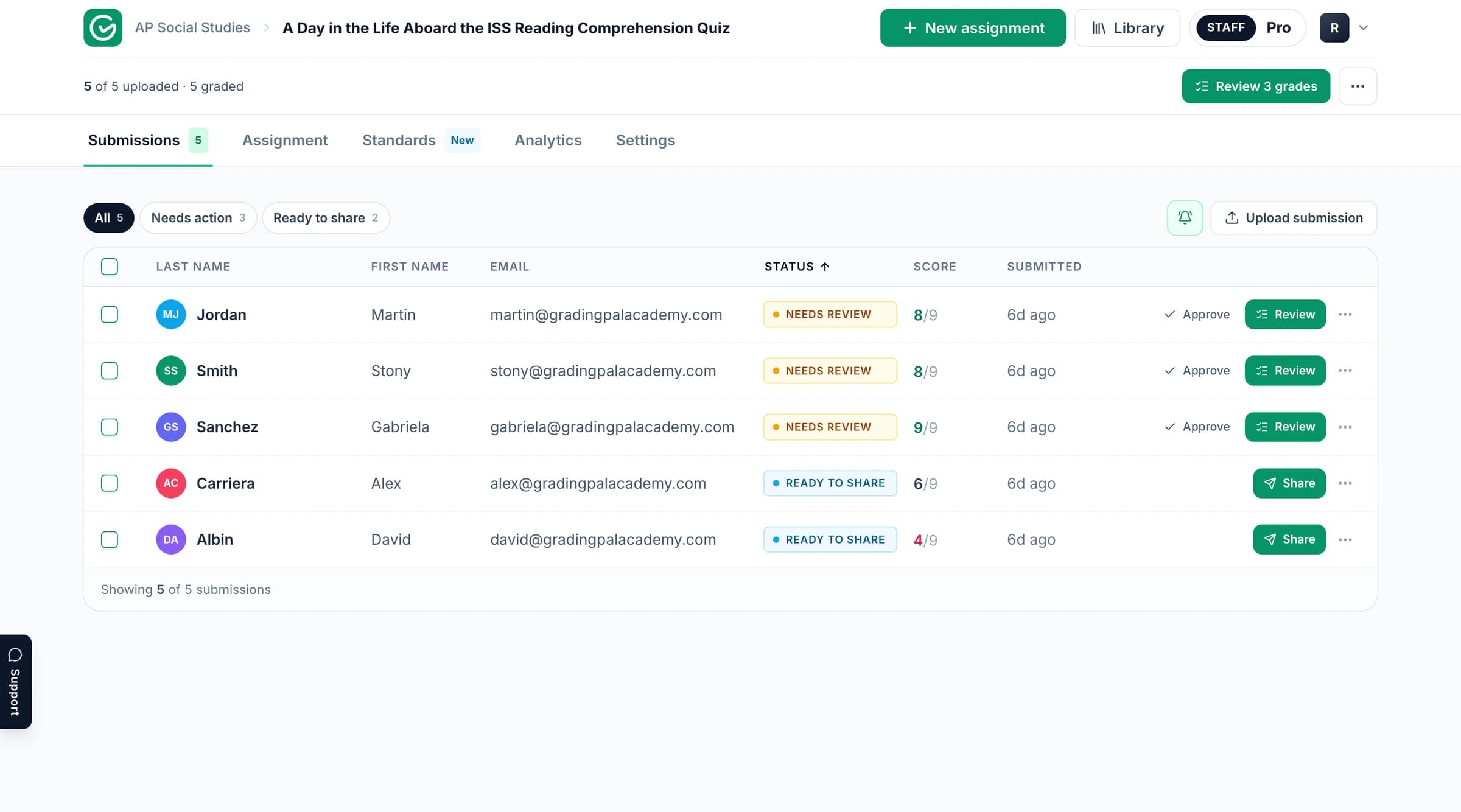
The GradingPal workspace. Product context; the published example and its media follow below.
Read the assignment and assessment example
Explore the original task and supporting material below. Follow the connection between the student’s response, the criteria being assessed, and the resulting assessment. The example provides its own context and evidence.
GradingPal is an AI grading assistant for teachers: upload student work and a rubric, and it drafts scores and specific, evidence-based feedback for you to review, edit, and release. In this use case, we'll follow a handwritten climate change response through a two-point rubric that turns out to be far more demanding than its point value suggests, all the way to a class dashboard that names the specific students to check in with.
The problem
Some of the hardest grading isn't about scale, it's about precision on a small task. A two-point earth science response can still be judged against five distinct required ideas, and it can still hinge on a distinction as subtle as where a causal chain actually starts. A student can write confidently and correctly about climate impacts and still miss the one earlier link, that human activity is what's driving the change, and a quick read easily gives credit for a chain that's actually one step short.
That's the gap between explaining an effect and explaining a cause, and NGSS cares about exactly that distinction. It's easy to miss on a stack of handwritten notebook pages, especially when the rubric itself is short enough to feel like a quick check rather than a five-point content review.
This is where GradingPal helps. It reads a rubric's fine print as closely as a person would, checking every required component individually, and it catches the difference between a student describing what climate change does and a student explaining what's actually causing it.
The assignment
The assignment: the climate skeptics human impact analysis task
Short assignment
In this earth science performance task, students revisit an earlier greenhouse gases lesson to make and support a claim about how climate-related hazards will likely affect human populations in the near future. They have to work in real projected data on temperature change and other climate shifts, connect it to how those changes reshape human lives, and land on a clear, evidence-based prediction.
It's a short response, but a demanding one. The rubric alone carries the grading logic here, no separate notes required, and it asks students to reason like a scientist in just a few paragraphs: name real mechanisms, trace real consequences, and be explicit about what's actually driving the change.
The rubric
The two-criterion rubric inside GradingPal
Two-point rubric
The rubric only has two criteria, Explanation and Cause and Effect, each worth a single point on a Developing or Proficient scale. But the Explanation criterion alone spells out five specific things a Proficient response has to hit: how rapid climate change has affected populations in the past, how it could impact the AMOC ocean circulation system, how melting ice has already affected people, how it's affected food supplies, and how it could continue to drive displacement and migration, all tied together with real scientific reasoning. Missing even one caps the score at Developing.
The Cause and Effect criterion is even more precise. It doesn't just ask whether the response describes climate impacts, it requires the response to explicitly trace the chain back to human activity as the driver, not just the consequences that follow from it. Two points on paper, five-plus things to actually verify: that's the kind of rubric that rewards a close read, and GradingPal grades to exactly that level of detail, whether the rubric is uploaded as-is or built and refined inside GradingPal first.
The graded submissions
The teacher uploads a photo of the student's handwritten notebook page, and GradingPal reads it and checks it against each required component in turn.
The graded submission: handwritten response with targeted feedback comments
Rubric-based scoring
Explanation and evidence for scores
Targeted feedback comments flagging areas of improvement
1 / 3
One response scores 1 out of 2. On Explanation, GradingPal credits real content, food supply issues, migration, melting ice, but stays at Developing because the response never addresses the AMOC requirement, one specific missing piece out of the five, named exactly. On Cause and Effect, the reasoning is even sharper: the student does explain how climate change leads to disasters and hardship, but the response never mentions human activity, greenhouse gas emissions, as what's driving the climate change in the first place. It's a cause-and-effect chain that starts one link too late, and that's precisely what keeps it at Developing rather than Proficient.
The feedback comments sit directly on the student's own handwriting. One credits the clear opening thesis by quoting it back. Another names the exact fix needed for Cause and Effect: mention how human actions like greenhouse gas emissions cause the changes being described. A third catches a spelling slip, 'didasturs' for 'disasters', framed as a note on using precise scientific language. A fourth points back to the assignment's own request for evidence, suggesting specific data points like projected temperature change or sea-level rise. Every comment is grounded in the student's actual words, and every one can be edited or deleted before anything is released.
Classwide analytics
The class dashboard: score distribution and named student follow-up
AI-generated analytics
Strengths & weaknesses
Recommendations for growth
1 / 3
Across the class, the pattern matches the individual response almost exactly. The AI-written summary puts it precisely: students are closer to understanding the consequences of climate change than to explaining the causal story behind them. Many can describe what happens to people, fewer can trace it back to what's actually causing it. The class mean sits at 74 percent with a wide, 50-point spread, and both rubric criteria land in a similar range, Explanation at 76 percent and Cause and Effect at 72, showing the gap is spread across the class rather than isolated to one criterion.
The single largest weakness, missing the human-activity link, touches 16 of 29 students, and the dashboard shows exactly which student's response best illustrates it, alongside a separate named example of a strong response that gets the full causal chain right, melting glaciers to sea level rise to displacement in Bangladesh. The dashboard also surfaces named Top Performers and a Students to Follow Up With list, so a teacher isn't just looking at a percentage, they have a direct, clickable shortlist of exactly who to check in with next.
The recommendations follow the same data. A whole-class mini-lesson on tracing the full chain from human activity to climate change to human impact addresses the biggest gap, reaching over half the class, while smaller, more targeted sessions cover a planning routine for hitting every required component and a specific misconception clinic on how the AMOC actually redistributes heat, each scoped to the smaller group that actually needs it.
The outcome
Here's what changes when an earth and environmental science analysis runs through GradingPal:
The teacher gets a rubric read with the same precision on a two-point task as on a fifty-point one, every required component checked, every causal claim traced to where it actually starts.
The student gets told exactly which piece is missing and why it matters: you explained the effects clearly, now name what's actually causing them. That's a precise, fixable note, not a vague push for more detail.
And the class gets a plan with names attached, not just percentages: which students to follow up with, which response to hold up as a model, and which single lesson would help the majority of the room.
That's the point of a task like this in the first place. We don't just want students to describe what climate change does. We want them to reason all the way back to what's driving it, the way real scientific argument works. GradingPal makes it practical to check for that reasoning on every response, no matter how short the rubric looks on paper.
Review the scoring and feedback with your task in mind
Start with what the learner was asked to demonstrate. Check the submitted work alongside the rubric expectations and any scoring explanation included in the example. Consider whether the feedback identifies a specific strength or a next action the student can take.
When you grade your own work in GradingPal, review the proposed scores and supporting evidence before approving them. For a calculation, inspect methods and intermediate steps as well as the answer. For an explanation, examine the relationship between the claim, evidence, and reasoning. Your rubric determines what earns credit.
Take the assessment further in GradingPal
GradingPal combines rubric scoring with individual feedback, standards mastery, and classroom analytics. These are product capabilities to explore for your own teaching; the published example above demonstrates the material contained in its original record.
Shape the feedback students receive
Choose Targeted, Glow & Grow, Structured, Sandwich, Actionable, or Socratic feedback. Set detail, supported language, and instructions for your teaching voice, then review the comments before sharing. Explore student feedback.
Track progress beyond one assignment
Approved, aligned evidence can contribute to a standards mastery record across assessments. Inspect the original work, choose among five calculation methods, and use teacher adjustments with a reason. Explore standards mastery.
Plan the next teaching step
Classroom analytics surface strengths, weaknesses, and recommended instructional next steps. Use the evidence to consider targeted practice, small-group support, or a class explanation. Explore analytics.
Reuse criteria across your team
Copy and edit a starting point from the 500-rubric catalog, or bring your existing rubric. Shared assignment and rubric libraries on eligible plans help colleagues reuse assessment resources. Explore the rubric library.
Explore more assessment examples
Continue with related published examples below or browse the full collection. GradingPal supports writing, math, science, handwritten work, worksheets, exams, slides, and supported recordings; the grader pages explain the wider product range.
See how GradingPal prepares rubric scores, explains the credit with evidence, and writes individual feedback for review. Start with 50 submissions per month on the free plan and check pricing for feature and format access.