Algebra · Middle School · Grades 6-8 · Problem Sets
Common Core · TEKS
By GradingPal Team · July 4, 2026 · 7 min read
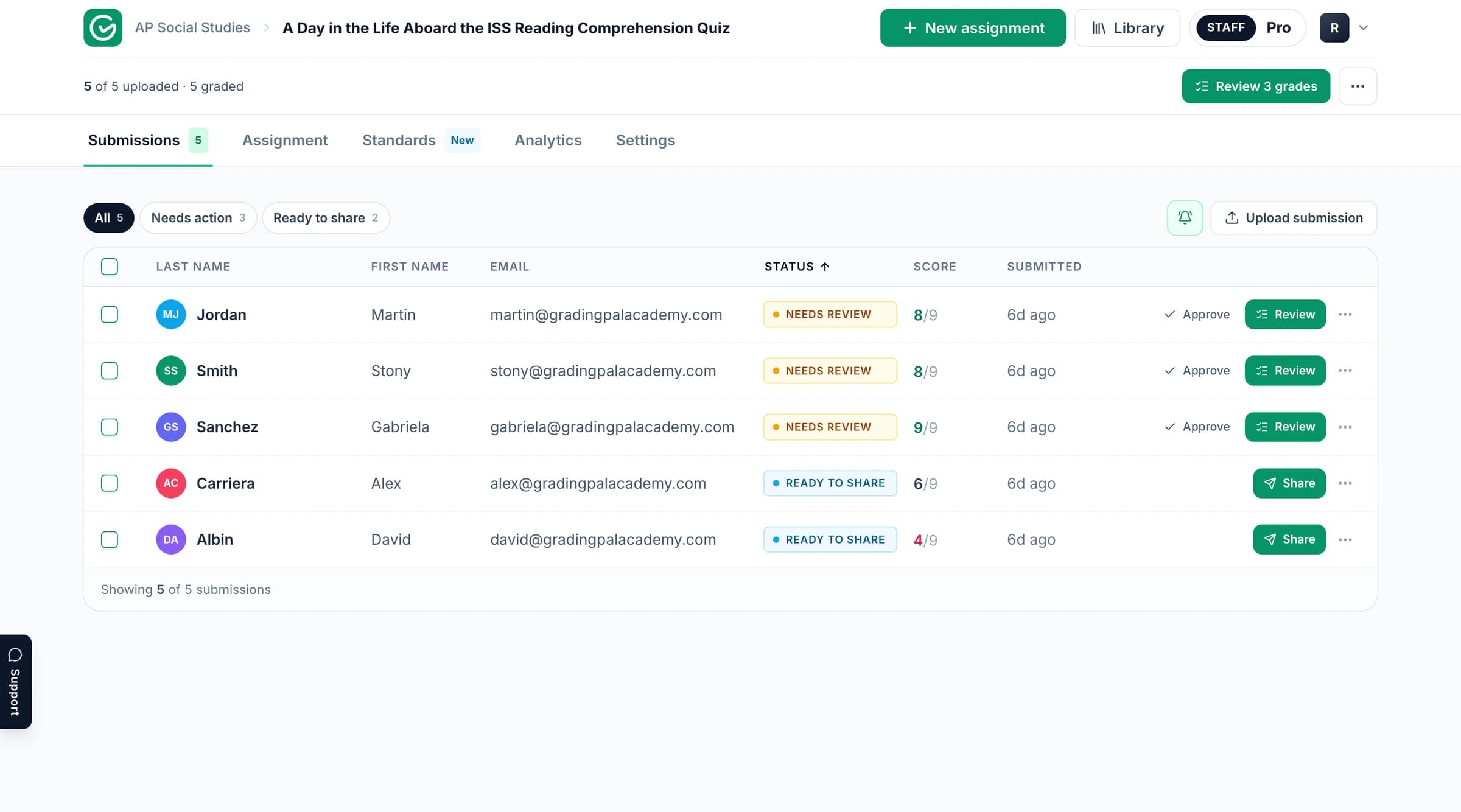
The GradingPal workspace. Product context; the published example and its media follow below.
Read the assignment and assessment example
Explore the original task and supporting material below. Follow the connection between the student’s response, the criteria being assessed, and the resulting assessment. The example provides its own context and evidence.
GradingPal is an AI grading assistant for teachers: upload student work and a rubric, and it drafts scores and specific, evidence-based feedback for you to review, edit, and release. In this use case, we'll follow a handwritten polynomial division test where a correct process and a correct final answer turn out to be two different things worth scoring separately.
The problem
Polynomial division is exactly the kind of math where grading only the final answer throws away most of the useful information. A student can set up a long division tableau correctly, carry every term through cleanly, and still lose the whole question to one small sign error near the end. Marked by the final answer alone, that student looks identical to one who never understood the process at all.
It gets harder on a handwritten test. A synthetic division ladder or a long division tableau is dense, multi-step scratch work, and a circled multiple-choice letter still needs to be read correctly before it can even be scored. Separating a real procedural strength from a real final answer, by hand, across a full class of scanned tests, eats time most teachers don't have.
This is where GradingPal helps. It reads the handwritten work, scores procedure and final answer as two separate, addable parts of the same question, and gives partial credit for a correct method even when the final answer is wrong.
The assignment
The assignment: the polynomial division and factoring test
Algebra problem set
This handwritten test covers polynomial long division, synthetic division, and the Remainder Theorem. Students divide a cubic polynomial by a quadratic, perform synthetic division on a cubic by a linear binomial, use synthetic division to evaluate a polynomial at a given value, and finish with a multiple-choice question asking which of four binomials is not a factor of a given quartic.
Every free-response question requires real scratch work, a full division tableau or a synthetic division ladder, not just a final boxed answer. That work is exactly what makes procedure and final answer worth grading as two separate things.
The rubric
The method-and-answer rubric inside GradingPal
Algebra rubric
Algebra rubric pt. 2
1 / 2
Each free-response question is scored on two independent criteria: Procedural Accuracy and Execution, worth the majority of the points, and Final Result and Interpretation, worth the rest. The long division rubric checks whether coefficients are handled correctly, including catching a missing term that needs a zero placeholder, entirely separately from whether the quotient and remainder are correctly identified at the end. The synthetic division and Remainder Theorem rubric goes further, explicitly distinguishing a student who runs the process correctly but reports the wrong value, the quotient instead of the remainder, say, from one who's fully correct.
The multiple-choice factoring question is scored simply, correct or incorrect, since there's no method to credit on a selected response. That's still your rubric, splitting method from answer wherever there's real work to evaluate, applied the same way across every test.
The graded submissions
The teacher uploads the scanned test, and GradingPal reads the handwritten tableaus and ladders directly, scoring procedure and final answer on each question.
The graded submission: handwritten division work scored on method and final answer
AI provides scores and overall feedback
AI scores feedback for every question
Areas of improvement
1 / 3
One test scores 15 out of 17, with full marks on all three free-response questions. On the long division problem, the feedback credits the specific move that made the setup work, writing the divisor with a zero placeholder for the missing term, and confirms the student's boxed answer is correct even though it's formatted slightly differently than the rubric's own model answer, recognizing a mathematically equivalent form rather than marking it wrong for looking different.
The multiple-choice question is where the score drops, and the feedback explains precisely why: the student's process was actually fine, a synthetic-division-style check, but they matched the wrong root to the wrong binomial and picked the incorrect option. The improvements panel shows the student's selected answer against the correct one side by side, and names the exact concept to revisit, how a binomial factor connects to its root.
If GradingPal misreads a circled letter on a multiple-choice item, the teacher can correct it directly before anything is scored or released. Every score and comment stays editable throughout.
Classwide analytics
The class dashboard: procedure versus conceptual understanding
Classroom performance overview
Scores table
Question-by-question analysis
1 / 3
Across the class, the mean sits at just 44.6 percent with a wide spread, and the AI-written summary draws a sharp line: this class has partial procedural access to polynomial division, but the understanding is fragile once the procedure has to connect to actual meaning. Students can often start a familiar setup correctly, but performance drops when the task requires interpreting what synthetic division represents, or choosing the correct test value from a binomial. The routine is more secure than the reasoning behind it.
The question-by-question view backs that up directly. All four questions on this test come back tagged Hard, with correct rates as low as 24 percent, a clear signal that this entire test needs a whole-class reteach rather than a small-group review. And the scores table shows the pattern at the individual level too: several students score perfectly on the division questions but zero on the factor-identification item, isolating precisely which skill is the reteachable gap for each student.
The outcome
Here's what changes when an algebra problem set or unit test runs through GradingPal:
The teacher gets every handwritten problem scored on method and final answer separately, and can see immediately whether a low score means no understanding or a strong process undone by one small error.
The student gets feedback aimed at the real gap: your division process was strong and consistent, now review how a binomial factor connects to its root before you choose an answer. Credit where it's earned, and a precise note where it isn't.
And the class gets a clear signal on whether a whole test needs reteaching or just one specific question does, instead of a single average that can't tell the difference.
That's the point of grading method separately from answer in the first place. We don't just want the right number in the box. We want to know whether a student can actually execute the process, and whether they understand what it means, and those two things deserve two different scores. GradingPal makes it practical to check both, on every handwritten problem, every time.
Review the scoring and feedback with your task in mind
Start with what the learner was asked to demonstrate. Check the submitted work alongside the rubric expectations and any scoring explanation included in the example. Consider whether the feedback identifies a specific strength or a next action the student can take.
When you grade your own work in GradingPal, review the proposed scores and supporting evidence before approving them. For a calculation, inspect methods and intermediate steps as well as the answer. For an explanation, examine the relationship between the claim, evidence, and reasoning. Your rubric determines what earns credit.
Take the assessment further in GradingPal
GradingPal combines rubric scoring with individual feedback, standards mastery, and classroom analytics. These are product capabilities to explore for your own teaching; the published example above demonstrates the material contained in its original record.
Shape the feedback students receive
Choose Targeted, Glow & Grow, Structured, Sandwich, Actionable, or Socratic feedback. Set detail, supported language, and instructions for your teaching voice, then review the comments before sharing. Explore student feedback.
Track progress beyond one assignment
Approved, aligned evidence can contribute to a standards mastery record across assessments. Inspect the original work, choose among five calculation methods, and use teacher adjustments with a reason. Explore standards mastery.
Plan the next teaching step
Classroom analytics surface strengths, weaknesses, and recommended instructional next steps. Use the evidence to consider targeted practice, small-group support, or a class explanation. Explore analytics.
Reuse criteria across your team
Copy and edit a starting point from the 500-rubric catalog, or bring your existing rubric. Shared assignment and rubric libraries on eligible plans help colleagues reuse assessment resources. Explore the rubric library.
Explore more assessment examples
Continue with related published examples below or browse the full collection. GradingPal supports writing, math, science, handwritten work, worksheets, exams, slides, and supported recordings; the grader pages explain the wider product range.
See how GradingPal prepares rubric scores, explains the credit with evidence, and writes individual feedback for review. Start with 50 submissions per month on the free plan and check pricing for feature and format access.