English / ELA · Middle School · Grades 6-8 · Essays/Writing
Common Core
By GradingPal Team · July 4, 2026 · 7 min read
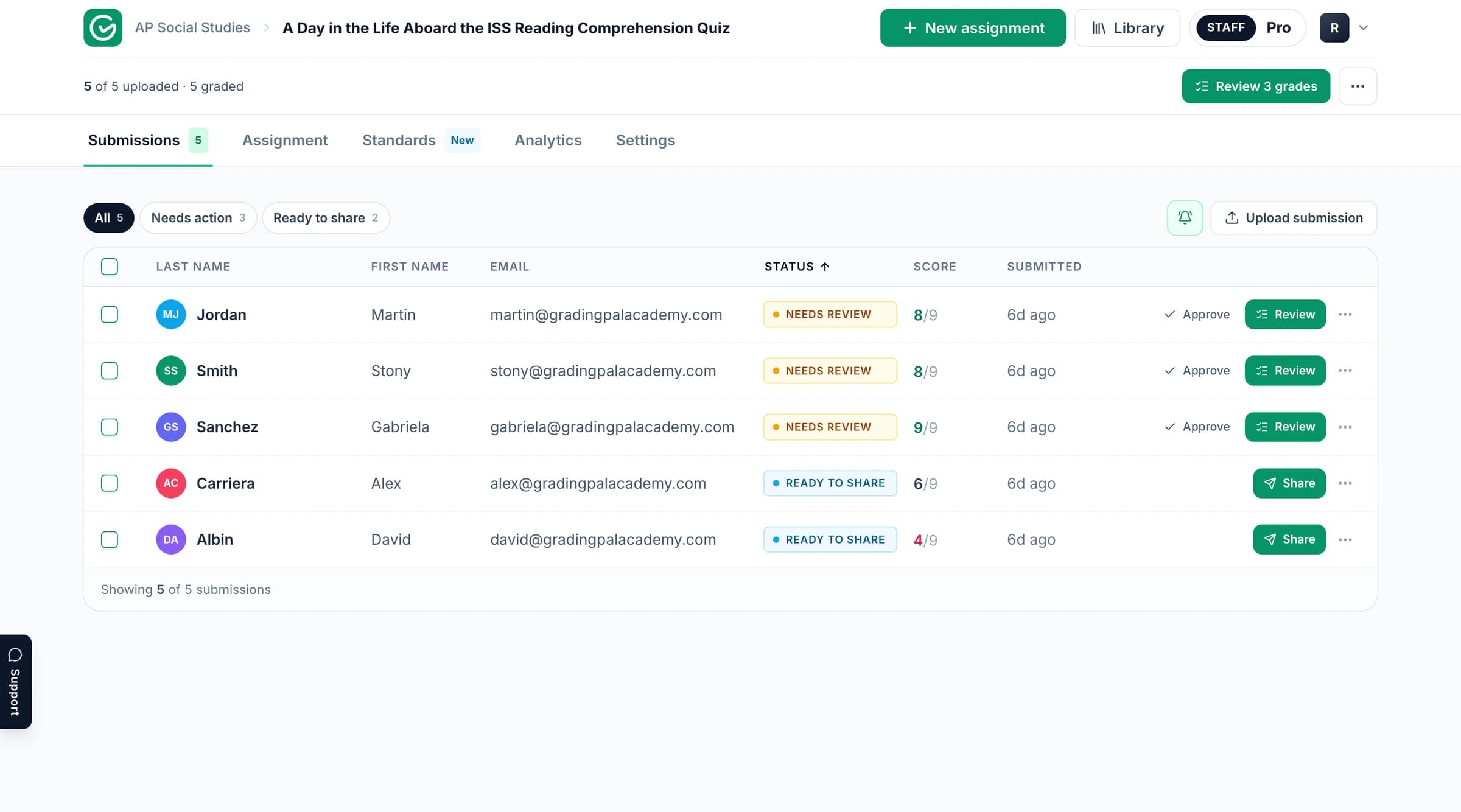
The GradingPal workspace. Product context; the published example and its media follow below.
Read the assignment and assessment example
Explore the original task and supporting material below. Follow the connection between the student’s response, the criteria being assessed, and the resulting assessment. The example provides its own context and evidence.
GradingPal is an AI grading assistant for teachers: upload student work and a rubric, and it drafts scores and specific, evidence-based feedback for you to review, edit, and release. In this use case, we'll follow a full-length argumentative research essay through a 13-criterion rubric built around a teacher's own writing framework, all the way to a class dashboard that separates strong argument writing from shaky research mechanics.
The problem
A full argumentative essay asks a lot of a grader at once. Is the thesis actually arguable, or just descriptive? Does the evidence get analyzed or just quoted? Are the sources the assignment specifically requires, primary sources, recent sources, a minimum count, actually there? A paper can read as strong and confident while quietly failing several of these requirements, and catching all of them consistently across a full class set of multi-page essays is a lot to hold in your head at once.
And most teachers already have their own way of teaching this, their own vocabulary for what good evidence use looks like, their own acronym for how a quote should be set up and unpacked. Grading well means applying that specific framework, not a generic one, to every single paper.
This is where GradingPal helps. It grades against your rubric, your own writing framework included, and applies it with the same consistency to the first essay and the forty-eighth.
The assignment
The assignment: the Gilded Age argumentative essay
Argumentative Essay
This 100-point argumentative essay asks students to define what the Gilded Age meant historically and argue whether today's United States amounts to a second Gilded Age. It's a full three to five page MLA paper with three required content pillars, wealth inequality, political corruption, and labor unrest, each needing specific historical examples plus a comparison to the last five years.
The sourcing requirements are specific and easy to shortchange under deadline pressure: a minimum of eight academic sources, including at least two genuine 19th-century primary sources and at least two from the last five years, all cited correctly in MLA with a properly formatted Works Cited page.
The rubric
The 13-criterion essay rubric inside GradingPal
Rubric part 1
Rubric part 2
Rubric part 3
1 / 3
The rubric spans 13 criteria and 100 points: thesis, introduction, three parallel content sections for wealth, corruption, and labor, evidence quality and research, conclusion, paragraph flow, and organization. One criterion is written entirely in the teacher's own classroom language, an evidence framework taught as an acronym, set up the quote, give the line of evidence, attribute the author in MLA, then explain the meaning and connect it back to the argument. GradingPal grades to that exact framework, not a generic substitute for it.
It's still your rubric and your own teaching vocabulary, applied the same way across every student's paper.
The graded submissions
The teacher uploads the student's essay, and GradingPal scores all 13 criteria, anchoring each one to the exact sentences that earn it.
The graded submission: highlighted evidence and expert-level revision coaching
AI grades the assignment and provides scores and feedback
Rubric scoring breakdown with evidence
Targeted feedback comments
1 / 3
One essay scores 90.5 out of 100, and the thesis earns a 9.5 out of 10 with the reasoning walking through exactly why: it establishes a historical definition of the Gilded Age, takes a clear, arguable position on a second Gilded Age, and previews the three subtopics that organize the rest of the essay. The introduction's evidence panel highlights two specific sentences directly, one confirming the historical definition, the other confirming the strong thesis statement.
Even where a section is already scoring well, the coaching goes further than a generic note. On the labor unrest section, a comment names the exact fix that would move it from Proficient to Excellent: replace a general observation with a specific event, the Pullman Strike of 1894 or the Homestead Strike, as a concrete historical anchor for the modern comparison being made. A second comment, tied to a quote about Rockefeller, suggests invoking the concept of Social Darwinism to deepen the historical analysis. That's genuinely subject-literate coaching, not a placeholder note to add more detail.
Nothing goes to the student until the teacher says so. Every score and comment is editable before release.
Classwide analytics
The class dashboard: argument skill versus research mechanics
Classroom performance overview
Strengths and weaknesses
Recommendations to improve performance
Scores table
1 / 4
Across the class, the mean sits at 85 percent with the tightest, most consistent distribution seen across a whole set of these assignments, and the AI-written summary draws a precise line between two different things: this class is much further along in historical argument than in academic research execution. Students can take a position, frame the comparison, and sustain it across a full paper. What holds many essays back isn't a lack of ideas, it's uneven command of the research architecture, sourcing, citation, that makes the argument credible.
The numbers back that up specifically. A large share of the class, 34 of 48 students, wrote analytically strong papers that still fell short of the assignment's exact sourcing rules, too few sources, too few primary or recent ones, with one Works Cited entry flagged as an irrelevant source cited only to hit a number. A separate, similarly sized group included full evidence and a complete Works Cited page but didn't consistently connect in-text citations back to it.
The recommendations scale to the size of each gap. Whole-class reteaches cover qualifying sources before drafting, MLA citation mechanics, and formatting expectations, since those touch most of the class, while two narrower small-group sessions target historical specificity in the weaker content sections and a lingering misconception about what actually counts as a valid 19th-century primary source.
The outcome
Here's what changes when an argumentative essay set like this runs through GradingPal:
The teacher gets a full-length essay graded on their own 13-criterion rubric, their own writing framework included, applied with the same consistency across every paper in the stack.
The student gets feedback specific enough to actually revise from: your argument is strong, now anchor it with the Pullman Strike instead of a general observation. That's expert-level coaching, not a generic push for more detail.
And the class gets a diagnosis that separates argument skill from research mechanics, with a reteach plan scaled to exactly how many students each specific gap actually affects.
That's the point of a full argumentative essay in the first place. We don't just want a confident-sounding position. We want a real thesis, real evidence handled the way the class was actually taught to handle it, and research that holds up to its own stated requirements. GradingPal makes it practical to check all of that, on every paper, at the length a real essay actually is.
Review the scoring and feedback with your task in mind
Start with what the learner was asked to demonstrate. Check the submitted work alongside the rubric expectations and any scoring explanation included in the example. Consider whether the feedback identifies a specific strength or a next action the student can take.
When you grade your own work in GradingPal, review the proposed scores and supporting evidence before approving them. For a calculation, inspect methods and intermediate steps as well as the answer. For an explanation, examine the relationship between the claim, evidence, and reasoning. Your rubric determines what earns credit.
Take the assessment further in GradingPal
GradingPal combines rubric scoring with individual feedback, standards mastery, and classroom analytics. These are product capabilities to explore for your own teaching; the published example above demonstrates the material contained in its original record.
Shape the feedback students receive
Choose Targeted, Glow & Grow, Structured, Sandwich, Actionable, or Socratic feedback. Set detail, supported language, and instructions for your teaching voice, then review the comments before sharing. Explore student feedback.
Track progress beyond one assignment
Approved, aligned evidence can contribute to a standards mastery record across assessments. Inspect the original work, choose among five calculation methods, and use teacher adjustments with a reason. Explore standards mastery.
Plan the next teaching step
Classroom analytics surface strengths, weaknesses, and recommended instructional next steps. Use the evidence to consider targeted practice, small-group support, or a class explanation. Explore analytics.
Reuse criteria across your team
Copy and edit a starting point from the 500-rubric catalog, or bring your existing rubric. Shared assignment and rubric libraries on eligible plans help colleagues reuse assessment resources. Explore the rubric library.
Explore more assessment examples
Continue with related published examples below or browse the full collection. GradingPal supports writing, math, science, handwritten work, worksheets, exams, slides, and supported recordings; the grader pages explain the wider product range.
See how GradingPal prepares rubric scores, explains the credit with evidence, and writes individual feedback for review. Start with 50 submissions per month on the free plan and check pricing for feature and format access.