Science · Middle School · Grades 6-8 · Essays/Writing
NGSS
By GradingPal Team · July 4, 2026 · 6 min read
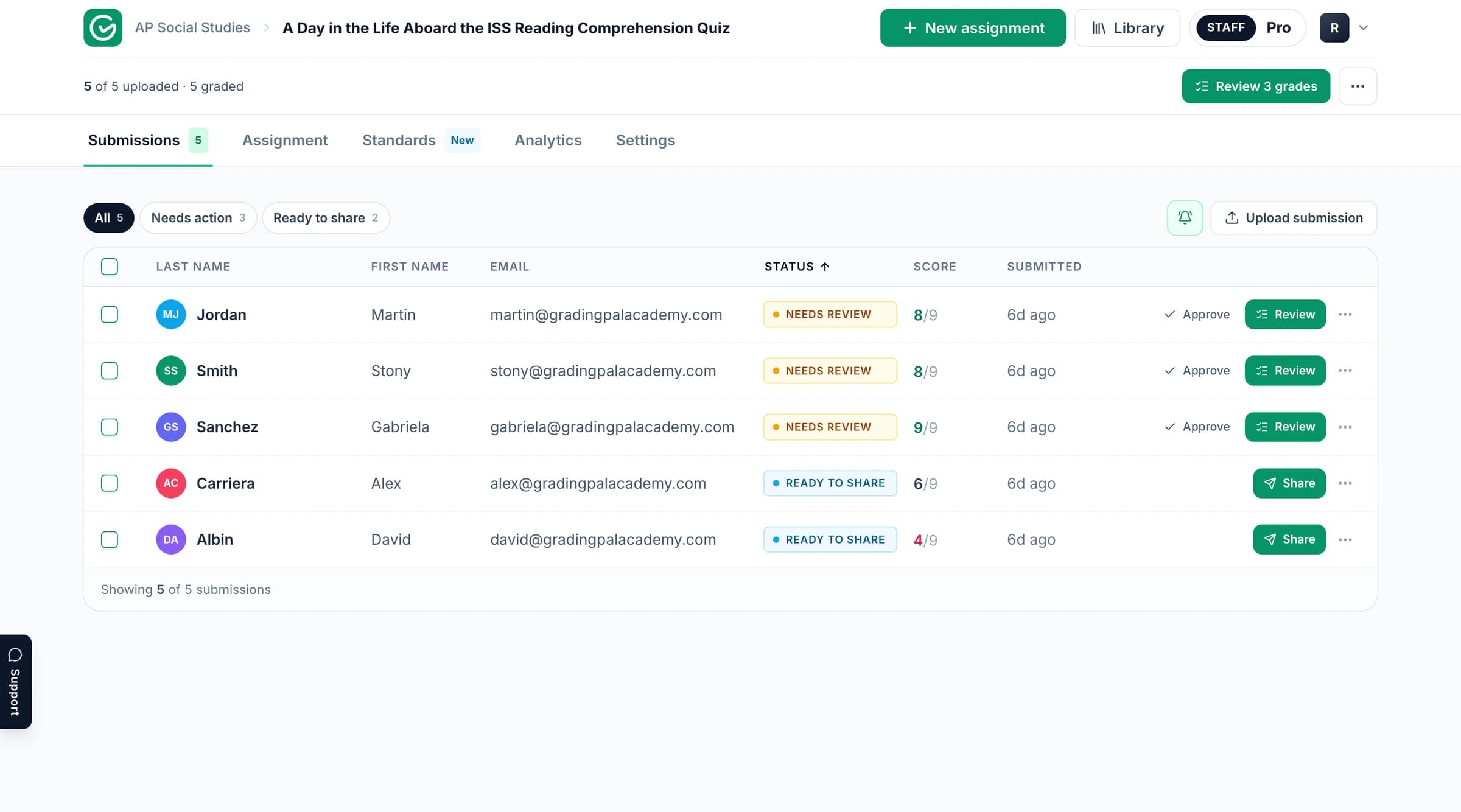
The GradingPal workspace. Product context; the published example and its media follow below.
Read the assignment and assessment example
Explore the original task and supporting material below. Follow the connection between the student’s response, the criteria being assessed, and the resulting assessment. The example provides its own context and evidence.
GradingPal is an AI grading assistant for teachers: upload student work and a rubric, and it drafts scores and specific, evidence-based feedback for you to review, edit, and release. In this use case, we'll follow a middle school science practical report through the part that's hardest to grade well: the claim, evidence, and reasoning students write to explain their results.
The problem
Claim-Evidence-Reasoning is the backbone of NGSS science writing, and it's deceptively hard to grade. One student states a strong claim and supports it with nothing. Another piles up data but never connects it back to the claim. A third reasons beautifully from evidence that isn't actually in their investigation. The breakdown is almost never the whole response; it's one of the three links in the chain.
That's exactly what a hurried grade misses. A 6 out of 10 with 'add more detail' doesn't tell a student whether their claim was fine and their reasoning was thin, or their reasoning was sound but rested on vague evidence. Without knowing which link failed, the student can't fix the right thing.
This is where GradingPal stands apart from pasting a response into a chatbot. It grades against your rubric, separates the claim from the evidence from the reasoning, and ties every comment to what the student actually wrote, so feedback lands on the specific link that broke.
The assignment
The assignment: the Growing Bacteria practical report
Growing bacteria assessment
Biology assignment page 2
Biology assignment page 3
1 / 3
In this Year 9 science investigation, students test how much bacteria grows on everyday surfaces. They swab an object of their choice, like a phone screen, a keyboard, or a door handle, streak it across an agar plate, incubate it for a day or two, and count the colonies that grow.
The write-up is where the argumentation lives. Students identify their variables, commit to a hypothesis in an if/then/because structure, record colony counts in data tables, and then, in the discussion, rank the swabbed surfaces from the shared class data and explain that ranking. That final step is claim-evidence-reasoning in its purest form: the claim is which surface carried the most bacteria, the evidence is the counts from the class table, and the reasoning is the scientific explanation that ties them together.
It's typical of real student work: promising but uneven. The investigation is sound and the data gets recorded, but some claims rest on loosely described evidence, some reasoning stays vague, and the scientific terminology drifts, with a hypothesis reasoned well on one page and a variable named imprecisely on another.
The rubric
The multi-part rubric inside GradingPal
Rubric
Rubric
1 / 2
The teacher applies a multi-part rubric built for this report, with separate criteria for the independent and dependent variables, the hypothesis, the colony sketch, the data tables, and the evidence-based discussion. Each criterion carries its own point value and written performance levels, running from No Credit through Exemplary.
The criterion that matters most for argumentation is the discussion. It doesn't ask whether the answer is right. It asks whether the student's ranking rests on specific data from the investigation and sound scientific reasoning, rather than a vague or unsupported claim. That scores the claim, the evidence, and the reasoning as distinct things, which is what lets feedback point at the exact link that failed instead of grading the paragraph as one lump.
And it grades to your rubric, not to a generic standard. Teachers can upload an existing rubric, build one in GradingPal, or have it draft one from the assignment and edit from there. The same rubric then applies to every submission, so a claim backed by real evidence earns the same credit on the first paper and the thirtieth.
The graded submissions
The teacher uploads the student's paper, handwritten in cursive with crossed-out attempts and hand-drawn colony sketches, and GradingPal reads the scan and grades each question against its matching rubric criterion. No retyping, and no clean digital copy required.
The graded submission: scanned student paper with per-question scores and feedback
Rubric-based scoring
Rubric-based feedback
Areas of Improvement
Strengths
1 / 4
The result is a per-question breakdown, not a single grade. This student lands at 28.5 out of 34, about 84 percent, with all fourteen questions scored. Each one carries a score plus tabs for Feedback, Strengths, and Improvements, and every score and comment is editable.
The feedback reads like it came from someone who actually read the paper. On the dependent variable, the student wrote seeing the bacteria growth growth; GradingPal credits the correct underlying idea, awards full marks, and suggests the more precise phrasing 'amount of bacterial growth.' On the discussion, it credits the specific surface locations and counts the student recorded, then flags why marks were lost: missing descriptions, and numbers that read as row labels rather than actual colony counts. Evidence feedback and reasoning feedback stay separate, so the student can see the claim was fine and the evidence just needed tightening.
The overall summary pulls it together. It praises the clear hypothesis with logical reasoning and the strong experimental thinking about controls and sources of error, then lays out concrete next steps: use precise scientific terminology, support conclusions with specific data from the investigation, and prioritize reliability over ease of presentation. It closes by noting the student is close to full marks in several sections.
And nothing goes to the student until the teacher says so. Adjust a score, rewrite a comment, or keep GradingPal's version. Some teachers release the feedback directly; others use it as the starting point for a one-on-one conference.
Classwide analytics
Analytics: claim, evidence, and reasoning trends across the class
Student performance overview
Question-by-question analytics
Strengths & weaknesses
1 / 3
Once the whole set is graded, class analytics show the pattern across the group. When the discussion criterion comes back lowest across the class, with students making claims their evidence doesn't fully support, that's not thirty separate problems. It's one mini-lesson on connecting evidence to a claim before the next investigation. Grading stops being an endpoint and starts shaping what gets taught next.
The outcome
Here's what changes when a CER-heavy investigation runs through GradingPal:
The teacher gets hours back, and the thirtieth report gets the same careful read as the first, handwritten ones included, so scores stay consistent and fair across the class.
The student gets feedback that names the actual gap. Not 'add more detail,' but your claim is sound, your evidence needs specific counts, and your reasoning has to connect the two. That's what turns a graded lab report into a stronger scientific argument next time.
And the class gets better instruction, because the analytics turn a stack of individual grades into one clear picture of whether claim, evidence, or reasoning is the skill to reteach.
That's the point of claim-evidence-reasoning in the first place. We don't want students to fill in a lab sheet. We want them to make a claim, back it with evidence, and reason from one to the other the way scientists do. GradingPal makes it practical to grade that argument every time, not just when there's time.
Review the scoring and feedback with your task in mind
Start with what the learner was asked to demonstrate. Check the submitted work alongside the rubric expectations and any scoring explanation included in the example. Consider whether the feedback identifies a specific strength or a next action the student can take.
When you grade your own work in GradingPal, review the proposed scores and supporting evidence before approving them. For a calculation, inspect methods and intermediate steps as well as the answer. For an explanation, examine the relationship between the claim, evidence, and reasoning. Your rubric determines what earns credit.
Take the assessment further in GradingPal
GradingPal combines rubric scoring with individual feedback, standards mastery, and classroom analytics. These are product capabilities to explore for your own teaching; the published example above demonstrates the material contained in its original record.
Shape the feedback students receive
Choose Targeted, Glow & Grow, Structured, Sandwich, Actionable, or Socratic feedback. Set detail, supported language, and instructions for your teaching voice, then review the comments before sharing. Explore student feedback.
Track progress beyond one assignment
Approved, aligned evidence can contribute to a standards mastery record across assessments. Inspect the original work, choose among five calculation methods, and use teacher adjustments with a reason. Explore standards mastery.
Plan the next teaching step
Classroom analytics surface strengths, weaknesses, and recommended instructional next steps. Use the evidence to consider targeted practice, small-group support, or a class explanation. Explore analytics.
Reuse criteria across your team
Copy and edit a starting point from the 500-rubric catalog, or bring your existing rubric. Shared assignment and rubric libraries on eligible plans help colleagues reuse assessment resources. Explore the rubric library.
Explore more assessment examples
Continue with related published examples below or browse the full collection. GradingPal supports writing, math, science, handwritten work, worksheets, exams, slides, and supported recordings; the grader pages explain the wider product range.
See how GradingPal prepares rubric scores, explains the credit with evidence, and writes individual feedback for review. Start with 50 submissions per month on the free plan and check pricing for feature and format access.