Engineering · High School · Grades 9-12 · Essays/Writing
NGSS
By GradingPal Team · July 4, 2026 · 7 min read
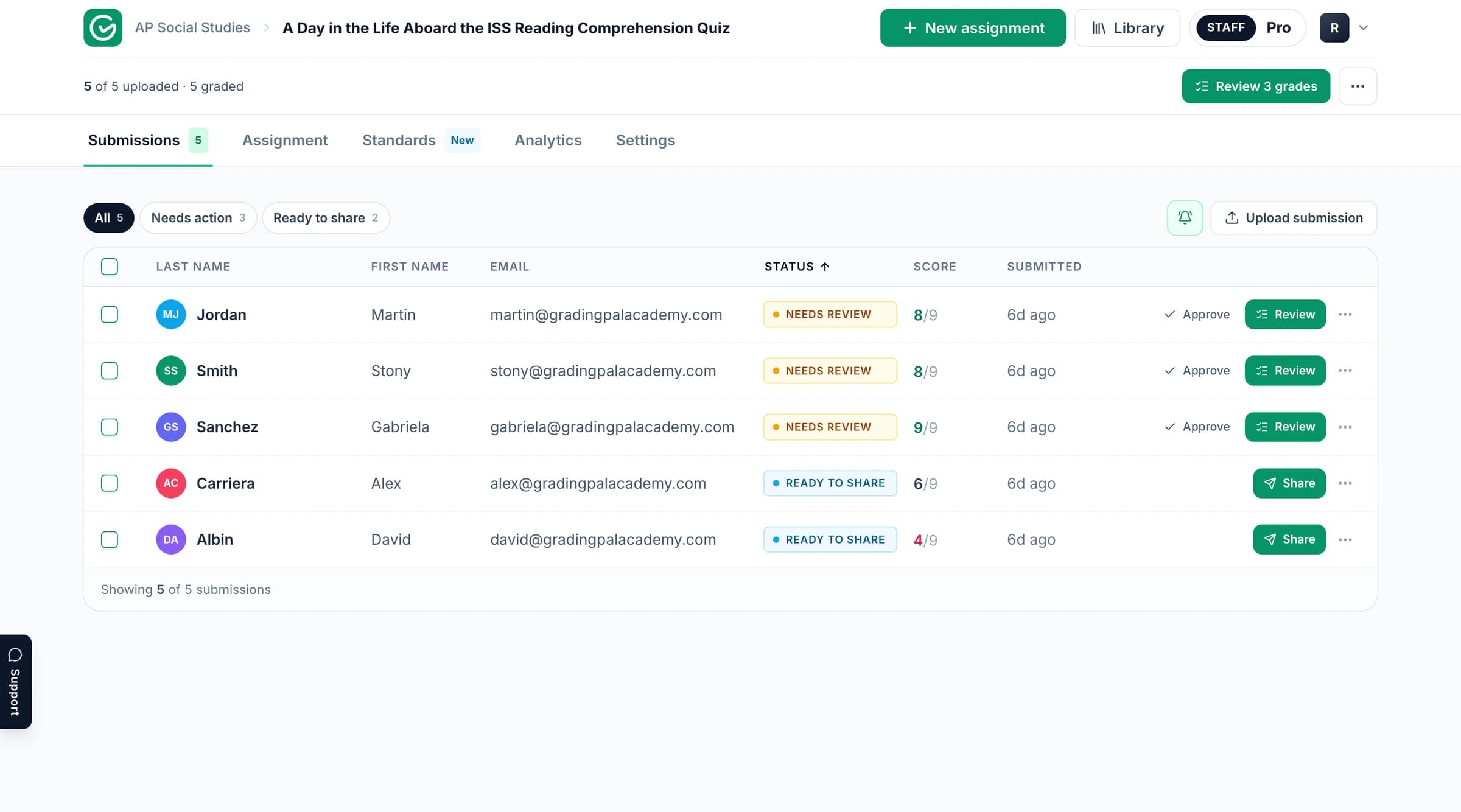
The GradingPal workspace. Product context; the published example and its media follow below.
Read the assignment and assessment example
Explore the original task and supporting material below. Follow the connection between the student’s response, the criteria being assessed, and the resulting assessment. The example provides its own context and evidence.
GradingPal is an AI grading assistant for teachers: upload student work and a rubric, and it drafts scores and specific, evidence-based feedback for you to review, edit, and release. In this use case, we'll follow the written half of a hands-on Stirling engine build, where an already strong answer still gets coached toward something better.
The problem
After students physically build something, the written explanation of how it works is where real understanding either shows up or doesn't. A student can correctly name every part of an engine and still not explain why it keeps running once it starts, and that gap, between describing components and explaining sustained motion over time, is subtle enough that a fast read tends to credit both the same way.
And even a strong, mostly correct explanation usually has room to go further, one more precise term, one more mechanism named. Most grading stops the moment an answer clears the bar for full credit, which means the highest-performing students rarely get feedback that pushes them past where they already are.
This is where GradingPal helps. It grades to your rubric, distinguishes naming a mechanism from actually explaining how it sustains motion, and keeps coaching toward the top tier even on a response that's already scoring well.
The assignment
The assignment: the Stirling engine written explanation
Writing explanation - how the Stirling engine works
After building a physical Stirling engine, students write an individual explanation of how it converts heat into motion. The explanation has to cover why a temperature difference is required, what happens to air when it's heated and cooled, how pressure changes cause motion, the distinct roles of the displacer and the power piston, why the crankshaft is offset by roughly 90 degrees, and how the rotational motion keeps going once the engine starts.
Six required terms have to appear and be used correctly: thermal expansion, pressure, volume, energy transfer, mechanical energy, and cyclic motion. It's a written task, but it's really asking students to explain the engine they physically built, not recite a definition.
The rubric
The four-criterion design rationale rubric inside GradingPal
Rubric
The teacher applies a four-criterion rubric worth 20 points: thermodynamic principles and air behavior, the mechanical roles of the two pistons, the timing and sustained motion created by the crankshaft offset, and correct use of the required vocabulary. Each one is scored in point ranges, with the top band itself spanning two points, which leaves room to distinguish a merely correct answer from a genuinely comprehensive one.
The timing criterion is the one built to catch the hardest distinction in the whole assignment. It doesn't award full marks just for mentioning the 90 degree offset or noting the engine keeps spinning; it requires explaining why the offset keeps the two pistons out of phase, and how momentum carries the cycle through the moments when pressure isn't actively pushing anything. That's still your rubric, applied the same way to every student's write-up.
The graded submissions
The teacher uploads the student's written explanation, and GradingPal reads it against all four criteria, anchoring every score to the student's own sentences.
The graded submission: quoted evidence and in-line coaching on an already-strong answer
AI grades submission based on rubric
Explanation and evidence for rubric scores
Targeted feedback comments
1 / 3
One explanation scores 19 out of 20, earning full marks on thermodynamic principles by clearly naming the temperature gradient as the driving force and connecting molecular motion to the resulting pressure and volume changes. GradingPal quotes the exact sentence that earns that credit, and a comment praises the specific connection between thermal expansion and pressure as a strong grasp of the underlying physics, not just a rubric checkbox.
Where it gets genuinely interesting is the 90 degree offset passage. The student's explanation is already correct, and it's credited as such, but a comment on that exact passage still pushes further: it suggests explaining how the phase shift specifically keeps the engine from stalling at the pistons' dead centers, the points where they change direction, which is exactly the language needed to reach the rubric's absolute top tier. That's coaching aimed at a student who's already doing well, not just confirming they passed.
Every comment is grounded in the student's own words, and every one can be edited or deleted before anything is released. If a teacher wants to shift the tone or depth across the whole set of comments at once, an Adjust All Feedback option can regenerate every annotation with a quick preset, simpler language or more detail, or a custom instruction, instead of editing each one by hand.
Classwide analytics
The class dashboard: thermodynamics mastery versus sustained-motion reasoning
Performance overview
Class-wide strengths & weaknesses
Scores breakdown table
1 / 3
Across the class, the mean sits at 85.9 percent, and the AI-written summary draws exactly the distinction the individual example hinted at. Students largely understand the thermodynamic cycle and can connect temperature-driven pressure changes to mechanical work. The drop-off happens when the explanation has to move from naming parts and effects to explaining sequencing over time, specifically how timing and stored rotational energy keep the cycle continuous rather than a list of separate cause-and-effect statements.
The numbers back it up precisely. Every student in the class correctly distinguished the displacer's role from the power piston's, and nearly all of them explained the thermodynamics well. But 11 of 17 students left the 90 degree offset only partially explained, stating that it affects timing without ever explaining the out-of-phase relationship or why it matters, and 10 of 17 mentioned the flywheel or continued spinning without explaining momentum or how the engine carries through its low-power moments, the same gap named in the individual example above, this time at the scale of the whole class.
The outcome
Here's what changes when an engineering design explanation runs through GradingPal:
The teacher gets feedback that keeps working even on the strongest submissions, pushing a nineteen-out-of-twenty answer toward the specific language that would make it a twenty, not just marking it done.
The student gets told exactly what would deepen an already-good answer: you correctly named the offset, now explain how it stops the engine from stalling at the dead centers. That's growth-oriented feedback even for a student who's already succeeding.
And the class gets a precise diagnosis, strong on static component knowledge and weaker on explaining sustained motion over time, which points directly at a specific mini-lesson rather than a vague sense that some students need to write more.
That's the point of pairing a build with a written explanation in the first place. We don't just want students to build something that works. We want them to explain why it works, including the parts that unfold over time, the way real engineering reasoning requires. GradingPal makes it practical to check for that depth on every explanation, including the ones that already look finished.
Review the scoring and feedback with your task in mind
Start with what the learner was asked to demonstrate. Check the submitted work alongside the rubric expectations and any scoring explanation included in the example. Consider whether the feedback identifies a specific strength or a next action the student can take.
When you grade your own work in GradingPal, review the proposed scores and supporting evidence before approving them. For a calculation, inspect methods and intermediate steps as well as the answer. For an explanation, examine the relationship between the claim, evidence, and reasoning. Your rubric determines what earns credit.
Take the assessment further in GradingPal
GradingPal combines rubric scoring with individual feedback, standards mastery, and classroom analytics. These are product capabilities to explore for your own teaching; the published example above demonstrates the material contained in its original record.
Shape the feedback students receive
Choose Targeted, Glow & Grow, Structured, Sandwich, Actionable, or Socratic feedback. Set detail, supported language, and instructions for your teaching voice, then review the comments before sharing. Explore student feedback.
Track progress beyond one assignment
Approved, aligned evidence can contribute to a standards mastery record across assessments. Inspect the original work, choose among five calculation methods, and use teacher adjustments with a reason. Explore standards mastery.
Plan the next teaching step
Classroom analytics surface strengths, weaknesses, and recommended instructional next steps. Use the evidence to consider targeted practice, small-group support, or a class explanation. Explore analytics.
Reuse criteria across your team
Copy and edit a starting point from the 500-rubric catalog, or bring your existing rubric. Shared assignment and rubric libraries on eligible plans help colleagues reuse assessment resources. Explore the rubric library.
Explore more assessment examples
Continue with related published examples below or browse the full collection. GradingPal supports writing, math, science, handwritten work, worksheets, exams, slides, and supported recordings; the grader pages explain the wider product range.
See how GradingPal prepares rubric scores, explains the credit with evidence, and writes individual feedback for review. Start with 50 submissions per month on the free plan and check pricing for feature and format access.