Engineering · High School · Grades 9-12 · Problem Sets
State Standards · NGSS
By GradingPal Team · July 4, 2026 · 7 min read
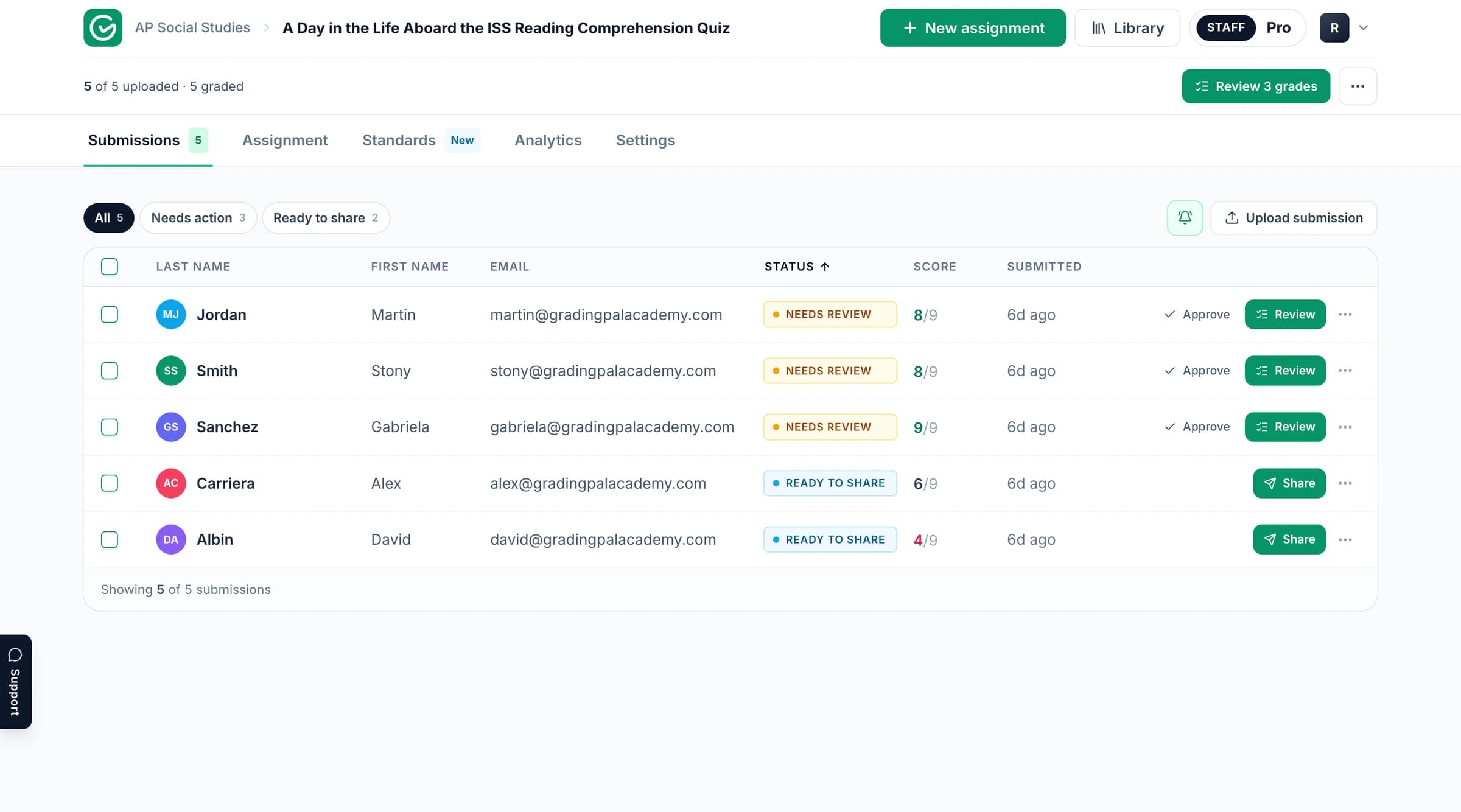
The GradingPal workspace. Product context; the published example and its media follow below.
Read the assignment and assessment example
Explore the original task and supporting material below. Follow the connection between the student’s response, the criteria being assessed, and the resulting assessment. The example provides its own context and evidence.
GradingPal is an AI grading assistant for teachers: upload student work and a rubric, and it drafts scores and specific, evidence-based feedback for you to review, edit, and release. In this use case, we'll follow a high school engineering statics worksheet on centroids, where correct math and a correct final answer turn out to be two different things worth checking separately.
The problem
Centroid problems look like simple arithmetic, but they hide two separate skills that don't always travel together: knowing the formula for each shape, and correctly reading the diagram's orientation to report the final coordinate the right way around. A student can compute every individual value flawlessly and still get the final answer marked wrong because x and y were reported swapped, or reversed relative to the diagram's axes.
The conceptual side is just as easy to blur under time pressure. A student who defines the centroid as a line of symmetry rather than a point isn't making a small vocabulary slip, they're conflating two genuinely different geometric ideas, and a fast grading pass often can't tell that apart from a student who simply forgot the term.
This is where GradingPal helps. It grades against your worked answer key and rubric, checks each coordinate individually against the diagram, and can tell a genuine conceptual mix-up from a correct method reported the wrong way around.
The assignment
The assignment: HW4.1 Centroids of Basic Shapes
Assignment part 1
Assignment part 2
1 / 2
This engineering statics worksheet opens with three conceptual fill-in-the-blank questions on what a centroid actually is and how symmetry locates it, then moves into direct calculations: find x̄ and ȳ for a rectangle, a square, a right triangle, and a semicircle, each with its own labeled diagram. A mixed-practice section repeats the calculations on two more shapes and closes with an open-ended question: why does symmetry make finding the centroid easier?
Every calculation problem comes with its own diagram, and students have to read dimensions and reference axes off that diagram correctly before the arithmetic even starts. Getting the formula right isn't the finish line; reporting the coordinate correctly relative to the diagram's orientation is a separate, and separately gradable, skill.
The rubric
The per-coordinate rubric inside GradingPal
Rubric part 1
Rubric part 2
Rubric part 3
Rubric part 4
Rubric part 5
1 / 5
Rather than one grade per shape, the rubric scores each coordinate separately, x̄ and ȳ each worth their own point, across roughly fifteen sub-questions. Each one carries a fully worked reference answer built into the rubric text itself: for the 10 by 6 rectangle, x̄ should be 3 inches and ȳ should be 5 inches, derived directly from the shape's dimensions. The fill-in-the-blank items accept genuine synonyms, center of mass or center of gravity both count, but hold the line on precision where it matters, requiring the exact phrase intersection of the lines of symmetry rather than a vaguer restatement.
Each rubric item also anticipates the specific wrong answer a common mistake produces, using one-third instead of one-half for a triangle's centroid, for instance, rather than just marking a wrong number incorrect. That's still your answer key, worked out coordinate by coordinate, applied the same way to every submission.
The graded submissions
The teacher uploads a photo of the student's handwritten worksheet, and GradingPal reads each diagram and its accompanying work, checking every coordinate against the rubric's worked answer.
The graded submission: coordinate-by-coordinate scoring and concept-level feedback
AI scores submissions based on rubric, with feedback
Strengths and areas of improvement
Rubric-based scoring
1 / 3
One student answers every fill-in-the-blank correctly and scores a clean 18 out of 18, with feedback that quotes their own phrasing, center of gravity, back to them as the correct answer and explains why that understanding underlies every calculation that follows.
A second student gets every calculation right but stumbles on two of the conceptual questions, writing line of symmetry where the centroid definition was asked for, and cross section where the rubric wanted intersection of the lines of symmetry. GradingPal doesn't just mark these wrong, it diagnoses the actual confusion: the feedback explains that a centroid is a point, the geometric center, not a line, and suggests practicing the distinction between a point of concurrency and a line of symmetry. That's coaching aimed at the specific geometric idea the student mixed up, not a generic note to review vocabulary.
And nothing goes to the student until the teacher says so. Every score and comment is editable, adjust a point, rewrite a note, or release it as GradingPal drafted it.
Classwide analytics
The class dashboard: per-question difficulty across two class sections
AI generates insights
Question-based analytics
Strengths and weaknesses
Scores table
1 / 4
One class section averages 65 percent, and the summary correctly reads the pattern: students handle single rules in isolation but struggle to coordinate several of them into one fully correct final answer. The question-by-question view backs that up directly, one specific conceptual item comes in at just 5 percent correct, nearly the whole class missed it, giving the teacher an exact item to reteach rather than a vague sense that scores were low.
A second class section shows a genuinely different pattern, and the dashboard describes it differently rather than flattening both into the same story. This class averages higher, 82 percent, with a much wider spread, and the analytics catch something specific: the individual coordinate sub-questions score 100 percent almost across the board, but the combined question that asks for both x̄ and ȳ together scores 0 percent for the same students. The strengths and weaknesses view names it directly, difficulty with combined, parent-level answers, affecting 15 of 16 students, with an example showing a student whose math was entirely correct but whose final coordinates were reported swapped relative to the diagram's orientation. Flawless calculation, wrong final report, and the dashboard catches the difference.
The outcome
Here's what changes when a statics problem set runs through GradingPal:
The teacher gets every coordinate checked against a worked answer key, and can see whether a wrong final answer came from bad math or a correct calculation reported the wrong way around, two very different things to reteach.
The student gets feedback aimed at the actual gap. Not wrong answer, but your math was correct and the coordinates just needed to be reported the other way around, or here's the difference between a centroid point and a line of symmetry.
And the class gets a diagnosis specific to its own pattern, whether that's coordinating multiple rules at once or correctly reporting a combined final answer, instead of one generic note to practice more problems.
That's the point of a problem set like this in the first place. We don't just want the right number at the bottom of the page. We want students to understand the concept, apply the right method, and report the result correctly and consistently, the way real engineering work demands. GradingPal makes it practical to check for all three, on every coordinate, every time.
Review the scoring and feedback with your task in mind
Start with what the learner was asked to demonstrate. Check the submitted work alongside the rubric expectations and any scoring explanation included in the example. Consider whether the feedback identifies a specific strength or a next action the student can take.
When you grade your own work in GradingPal, review the proposed scores and supporting evidence before approving them. For a calculation, inspect methods and intermediate steps as well as the answer. For an explanation, examine the relationship between the claim, evidence, and reasoning. Your rubric determines what earns credit.
Take the assessment further in GradingPal
GradingPal combines rubric scoring with individual feedback, standards mastery, and classroom analytics. These are product capabilities to explore for your own teaching; the published example above demonstrates the material contained in its original record.
Shape the feedback students receive
Choose Targeted, Glow & Grow, Structured, Sandwich, Actionable, or Socratic feedback. Set detail, supported language, and instructions for your teaching voice, then review the comments before sharing. Explore student feedback.
Track progress beyond one assignment
Approved, aligned evidence can contribute to a standards mastery record across assessments. Inspect the original work, choose among five calculation methods, and use teacher adjustments with a reason. Explore standards mastery.
Plan the next teaching step
Classroom analytics surface strengths, weaknesses, and recommended instructional next steps. Use the evidence to consider targeted practice, small-group support, or a class explanation. Explore analytics.
Reuse criteria across your team
Copy and edit a starting point from the 500-rubric catalog, or bring your existing rubric. Shared assignment and rubric libraries on eligible plans help colleagues reuse assessment resources. Explore the rubric library.
Explore more assessment examples
Continue with related published examples below or browse the full collection. GradingPal supports writing, math, science, handwritten work, worksheets, exams, slides, and supported recordings; the grader pages explain the wider product range.
See how GradingPal prepares rubric scores, explains the credit with evidence, and writes individual feedback for review. Start with 50 submissions per month on the free plan and check pricing for feature and format access.