Biology · High School · Grades 9-12 · Essays/Writing
NGSS · Common Core
By GradingPal Team · July 4, 2026 · 7 min read
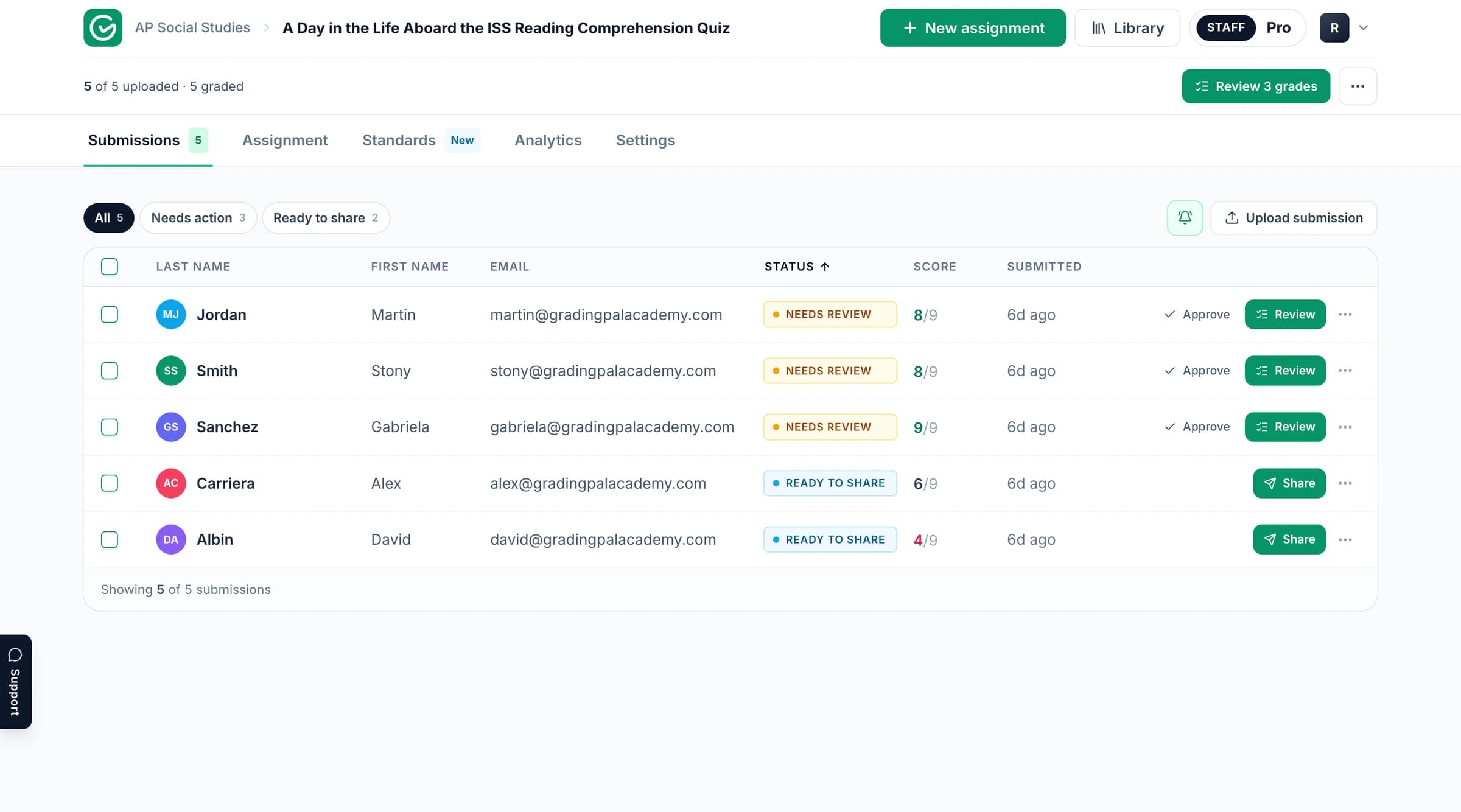
The GradingPal workspace. Product context; the published example and its media follow below.
Read the assignment and assessment example
Explore the original task and supporting material below. Follow the connection between the student’s response, the criteria being assessed, and the resulting assessment. The example provides its own context and evidence.
GradingPal is an AI grading assistant for teachers: upload student work and a rubric, and it drafts scores and specific, evidence-based feedback for you to review, edit, and release. In this use case, we'll follow a high school ecosystem case study through a rubric that scores claim, evidence, and reasoning as three separate skills, all the way to a per-student mastery view a teacher can track over time.
The problem
Claim-evidence-reasoning responses hide their weak points well. A student can write a confident, correct claim and back it with real evidence, and still never explain the actual mechanism connecting the two. Read quickly, that response looks complete. Read carefully, the reasoning section is just restating the claim in different words.
And once a stack of these is graded, most teachers still can't answer a more useful question: is this student's struggle with claim-writing, with finding evidence, or with reasoning specifically? A single overall score on a CER response collapses three distinct skills into one number, which makes it hard to track whether a student is actually improving at the piece they're weak in.
This is where GradingPal helps. It grades claim, evidence, and reasoning as separate criteria against your rubric, and rolls those scores up into a per-student view of exactly which science practice needs more work.
The assignment
The assignment: the Serengeti ecosystem case study
Biology lab part 1
Biology lab part 2
Biology lab part 3
1 / 3
This biology assignment builds around a real ecological case study, the Serengeti and the wildebeest migration. It opens with short-answer vocabulary questions on keystone species and biodiversity, moves into a structured data table where students map out species interactions, wildebeest, lions, plants, birds and insects, and how each one affects ecosystem stability, then closes with a formal claim-evidence-reasoning response to a single question: which interaction matters most for keeping the Serengeti stable?
The CER prompt has explicit parts: a one-sentence claim, at least two pieces of supporting evidence, and reasoning that explains why the interaction actually maintains stability. That structure, recall, then data synthesis, then a formal scientific argument, is what makes this assignment a genuine test of NGSS science practices rather than just content recall.
The rubric
The five-criterion rubric inside GradingPal
Grading Rubric
The teacher applies a five-criterion rubric worth 20 points: vocabulary and ecosystem concepts, interaction table accuracy, and then claim, evidence, and reasoning graded as three entirely separate criteria within the CER response. Each one is scored on a four-level scale, and the top level is written with real discipline-specific language, requiring terms like trophic levels or carrying capacity and a genuine cause-and-effect chain, not just a correct-sounding sentence.
Splitting claim, evidence, and reasoning into separate criteria is what makes the standards-mastery tracking possible later. A student's claim score and their reasoning score can move independently, because they're graded independently, on your rubric, applied the same way to every student's response.
The graded submissions
The teacher uploads the student's response, and GradingPal scores each of the five criteria individually, quoting the exact sentence that earns or costs credit.
The graded submission: claim, evidence, and reasoning scored separately with quoted evidence
Rubric-based AI scoring
Evidence and explanations for scores
Targeted feedback comments with highlights
1 / 3
One student's claim is highlighted directly and credited as a clear, one-sentence answer that names a specific interaction and its role, exactly what the rubric's top tier requires. The keystone species definition is praised for identifying the disproportionate impact a keystone species has on the whole ecosystem, not just its individual relationships, and even at a near-perfect score, the feedback offers a genuine extension: research functional niches, or consider which herbivores could realistically replace the wildebeest's role.
The feedback also catches the smaller things: a likely typo, gazing for grazing, gets corrected with the right ecological term in context. And on the evidence criterion, the coaching is specific about what would move a response from good to exemplary: naming actual organisms from the lesson materials, the dung beetle's role in nitrogen cycling, for instance, and citing real numbers, like the percentage of dung buried, instead of a general statement.
Every score and comment is editable before anything reaches the student, and the scoring and the coaching stay separate: one tells the student what they earned, the other tells them exactly what to write next time to earn more.
Classwide analytics
The class dashboard: a split distribution and per-skill mastery tracking
Performance Overview
Strengths & weaknesses
Rubric-based scores table
1 / 3
Across the full set, the dashboard doesn't just report a mean, it flags a genuine split: 34 students scored below 48 percent while 60 scored above it, a pattern a single average would completely hide. The AI-written summary reads the pattern precisely: students can name important ecosystem relationships and often start the CER with a workable claim, but many don't carry that through to a complete, evidence-based explanation. Performance drops hardest exactly where recall has to become elaboration, evidence and mechanism, not just a correct opening sentence.
Because claim, evidence, and reasoning are scored separately, the class-wide gap shows up exactly where it lives. A meaningful share of students left the CER section incomplete entirely, evidence of blank claim, evidence, or reasoning fields. A separate, larger group wrote a reasoning section that just restates the claim and evidence rather than explaining the actual ecological cause and effect. Those are two different problems, and the dashboard names them as two different weaknesses rather than one vague low score.
Because every CER sub-skill is its own column in the scores table, a teacher can track a specific student's claim score, evidence score, and reasoning score separately over time, not just their overall grade, which is what turns individual assignment scores into an ongoing view of standards mastery.
The outcome
Here's what changes when a CER-based biology assignment runs through GradingPal:
The teacher gets claim, evidence, and reasoning graded and tracked as three separate skills, not one blended score, and every score comes with the exact quote from the student's own response that earned it.
The student gets feedback aimed at the specific piece that's weak: your claim and evidence are strong, now explain the actual mechanism connecting them instead of restating what you already said. That's precise enough to actually act on.
And the class gets a diagnosis broken down by science practice, not just an average, with a per-student mastery view that shows whether a specific skill is actually improving assignment over assignment.
That's the point of a claim-evidence-reasoning task in the first place. We don't just want a correct answer at the end. We want students to make a claim, support it with real data, and explain the mechanism connecting the two, the way real scientific argument works, and we want to know exactly which of those three they're still building. GradingPal makes it practical to track all three, on every response, over time.
Review the scoring and feedback with your task in mind
Start with what the learner was asked to demonstrate. Check the submitted work alongside the rubric expectations and any scoring explanation included in the example. Consider whether the feedback identifies a specific strength or a next action the student can take.
When you grade your own work in GradingPal, review the proposed scores and supporting evidence before approving them. For a calculation, inspect methods and intermediate steps as well as the answer. For an explanation, examine the relationship between the claim, evidence, and reasoning. Your rubric determines what earns credit.
Take the assessment further in GradingPal
GradingPal combines rubric scoring with individual feedback, standards mastery, and classroom analytics. These are product capabilities to explore for your own teaching; the published example above demonstrates the material contained in its original record.
Shape the feedback students receive
Choose Targeted, Glow & Grow, Structured, Sandwich, Actionable, or Socratic feedback. Set detail, supported language, and instructions for your teaching voice, then review the comments before sharing. Explore student feedback.
Track progress beyond one assignment
Approved, aligned evidence can contribute to a standards mastery record across assessments. Inspect the original work, choose among five calculation methods, and use teacher adjustments with a reason. Explore standards mastery.
Plan the next teaching step
Classroom analytics surface strengths, weaknesses, and recommended instructional next steps. Use the evidence to consider targeted practice, small-group support, or a class explanation. Explore analytics.
Reuse criteria across your team
Copy and edit a starting point from the 500-rubric catalog, or bring your existing rubric. Shared assignment and rubric libraries on eligible plans help colleagues reuse assessment resources. Explore the rubric library.
Explore more assessment examples
Continue with related published examples below or browse the full collection. GradingPal supports writing, math, science, handwritten work, worksheets, exams, slides, and supported recordings; the grader pages explain the wider product range.
See how GradingPal prepares rubric scores, explains the credit with evidence, and writes individual feedback for review. Start with 50 submissions per month on the free plan and check pricing for feature and format access.