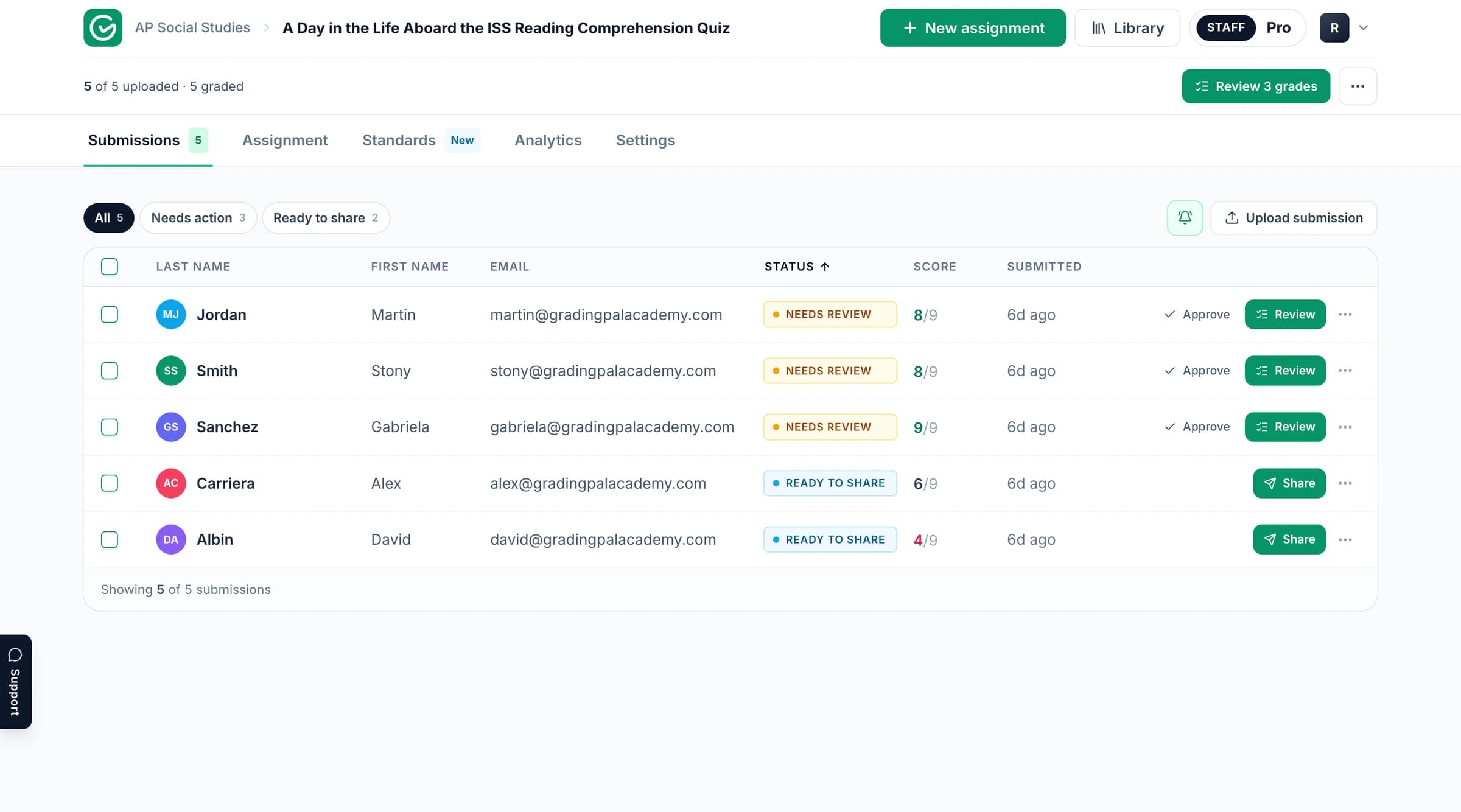
The GradingPal workspace. Product context; the published example and its media follow below.
Read the assignment and assessment example
Explore the original task and supporting material below. Follow the connection between the student’s response, the criteria being assessed, and the resulting assessment. The example provides its own context and evidence.
GradingPal is an AI grading assistant for teachers: upload student work and a rubric, and it drafts scores and specific, evidence-based feedback for you to review, edit, and release. In this use case, we'll follow a pendulum physics lab through the gap that trips up most students: getting the right conclusion is one thing, proving it with your own data is another.
The problem
A physics lab report can look complete and still fall short in the one place that matters most. A student can correctly say that a longer pendulum swings slower and never once point back to the actual seconds they measured. They can circle the right prediction, run the trials cleanly, and then write a conclusion that could apply to any data set, because it isn't grounded in theirs.
That gap is easy to miss on a stack of handwritten lab sheets. A grader skimming for the right answer will wave through a conclusion that happens to be correct, without checking whether the student actually cited their own numbers, or whether their own arithmetic even holds up against the raw times they recorded.
This is where GradingPal helps. It checks data for physical plausibility, recomputes a student's own calculations against their own raw numbers, and can tell a correct answer that's actually supported by evidence from one that's just a lucky guess.
The assignment
The assignment: the pendulum variables lab
Lab assignment pt. 1
Lab assignment pt. 2
1 / 2
In this physics lab, students test which of three variables, mass, amplitude, or length, actually affects a pendulum's period. They make a prediction for each variable before running any trials, then run three controlled tests, changing one variable at a time while holding the other two constant, timing ten swings and dividing by ten to find the period.
The analysis section is where the real thinking happens. Students have to state what each test showed, apply the length-period relationship to a real grandfather clock, and name one specific source of error in their own timing, not a vague nod to human error but an actual mechanism, like reaction time on the stopwatch or misjudging the exact moment a swing peaks.
The rubric
The multi-part lab rubric inside GradingPal
Rubric pt. 1
Rubric pt. 2
Rubric pt. 3
Rubric pt. 4
Rubric pt. 5
1 / 5
The rubric treats prediction, data collection, calculation, and conclusion as four separate things to check, not one lump grade. Pre-lab predictions earn credit just for making a genuine attempt, regardless of whether the guess turns out right, which protects the whole point of a prediction: finding out what students actually think before they see the data.
Data recording is checked for physical plausibility, not just presence. If a shorter string is recorded with a longer period than a longer string, that's flagged directly, since it contradicts the physics being tested. Calculations are checked against a worked reference, so a period computed from a raw time can be verified arithmetically. And every conclusion criterion asks for the same thing: not just the right answer, but the student's own numbers cited to support it.
It's still your rubric, built around what a real lab report should demonstrate, applied the same way to every student's data.
The graded submissions
The teacher uploads the student's lab sheet, and GradingPal reads the data tables, the predictions, and the written analysis together, checking each against the rubric and against the student's own recorded numbers.
The graded submission: data tables, recomputed calculations, and evidence-based feedback
AI grades handwriting and provides feedback
Detailed feedback on every question
Strengths & areas of improvement
1 / 3
One student scores 32 out of 36, with every pre-lab prediction credited for the honest attempt it represents, and strong marks on the grandfather clock application question. But the feedback catches something a quick read would miss: it recomputes the student's own short-string period from their own raw time of 7.8 seconds and finds they recorded 0.74 seconds where the math actually gives 0.78, a genuine arithmetic check against the student's own data, not a generic reminder to double check work.
On the amplitude analysis question, the feedback separates two things that are easy to conflate: the student's conclusion, that release height doesn't significantly change the period, is correct, and gets credited as correct. But the score stays at 3 out of 5 because the answer never cites the actual period values from the low and high release trials to show they were nearly identical. The improvements note is precise about the fix: cite the specific numbers, and explain the reasoning that connects them to the conclusion.
Nothing goes to the student until the teacher says so. Every score and comment is editable before it's released.
Classwide analytics
The class dashboard: application versus evidence-based reasoning
Performance overview
Class-wide strengths & weaknesses
Recommendations for growth
1 / 3
Across the class, the mean sits at 54.7 percent, and the AI-written summary draws a sharp, specific distinction: students are leaving the lab with parts of the right conclusion, but not yet with a stable scientific model or a strong lab-reporting habit. Applying the physics is far stronger than explaining it. Every single graded student, 25 out of 25, correctly applied the length-period relationship to the grandfather clock question. But only a small share supported their Test A and Test B conclusions with actual cited numbers from their own data.
The dashboard names that gap as the dominant class weakness, missing data-based evidence in analysis, affecting 22 of 25 students, and shows exactly what it looks like: one student's response reaches the correct conclusion about mass but never once mentions a specific time or period from her own Test A data to back it up. A second, smaller weakness shows up too, some students recognize length matters but never state which direction the relationship goes, longer string, longer period, leaving the mechanism unstated even when the observation is right.
The recommendations follow the size of each gap. A whole-class reteach on writing conclusions with claim, evidence, and reasoning addresses the biggest and most widely shared weakness, reaching 88 percent of the class, while a narrowly scoped small group session targets a specific misconception, that swing time comes from distance traveled rather than the true length-period relationship, affecting a much smaller slice of students.
The outcome
Here's what changes when a physics lab runs through GradingPal:
The teacher gets every calculation checked against the student's own raw data, and every conclusion checked for whether it's actually supported by evidence, not just whether it happens to be correct.
The student gets told exactly what's missing: your conclusion is right, now cite the specific numbers from your own data table that prove it, and even catches a real arithmetic slip against their own recorded times.
And the class gets a precise diagnosis, applying the physics well but not yet formally justifying it with evidence, translated into a whole-class lesson for the shared gap and a small group for the narrower misconception.
That's the point of a lab report in the first place. We don't just want students to land on the right answer. We want them to make a real prediction, collect honest data, and build a conclusion that their own numbers actually support, the way real scientific reporting works. GradingPal makes it practical to check for that, on every lab, every time.
Review the scoring and feedback with your task in mind
Start with what the learner was asked to demonstrate. Check the submitted work alongside the rubric expectations and any scoring explanation included in the example. Consider whether the feedback identifies a specific strength or a next action the student can take.
When you grade your own work in GradingPal, review the proposed scores and supporting evidence before approving them. For a calculation, inspect methods and intermediate steps as well as the answer. For an explanation, examine the relationship between the claim, evidence, and reasoning. Your rubric determines what earns credit.
Take the assessment further in GradingPal
GradingPal combines rubric scoring with individual feedback, standards mastery, and classroom analytics. These are product capabilities to explore for your own teaching; the published example above demonstrates the material contained in its original record.
Shape the feedback students receive
Choose Targeted, Glow & Grow, Structured, Sandwich, Actionable, or Socratic feedback. Set detail, supported language, and instructions for your teaching voice, then review the comments before sharing. Explore student feedback.
Track progress beyond one assignment
Approved, aligned evidence can contribute to a standards mastery record across assessments. Inspect the original work, choose among five calculation methods, and use teacher adjustments with a reason. Explore standards mastery.
Plan the next teaching step
Classroom analytics surface strengths, weaknesses, and recommended instructional next steps. Use the evidence to consider targeted practice, small-group support, or a class explanation. Explore analytics.
Reuse criteria across your team
Copy and edit a starting point from the 500-rubric catalog, or bring your existing rubric. Shared assignment and rubric libraries on eligible plans help colleagues reuse assessment resources. Explore the rubric library.
Explore more assessment examples
Continue with related published examples below or browse the full collection. GradingPal supports writing, math, science, handwritten work, worksheets, exams, slides, and supported recordings; the grader pages explain the wider product range.
See how GradingPal prepares rubric scores, explains the credit with evidence, and writes individual feedback for review. Start with 50 submissions per month on the free plan and check pricing for feature and format access.