Grade against your criteria. Track the standards you teach.
GradingPal connects rubric-based assessment to Common Core, NGSS, TEKS, standards across all 50 US states and Washington, D.C., and relevant AP, IB, and exam-board resources. Review alignment, approve the assessment, and turn student work into feedback and evidence of progress against selected learning goals.
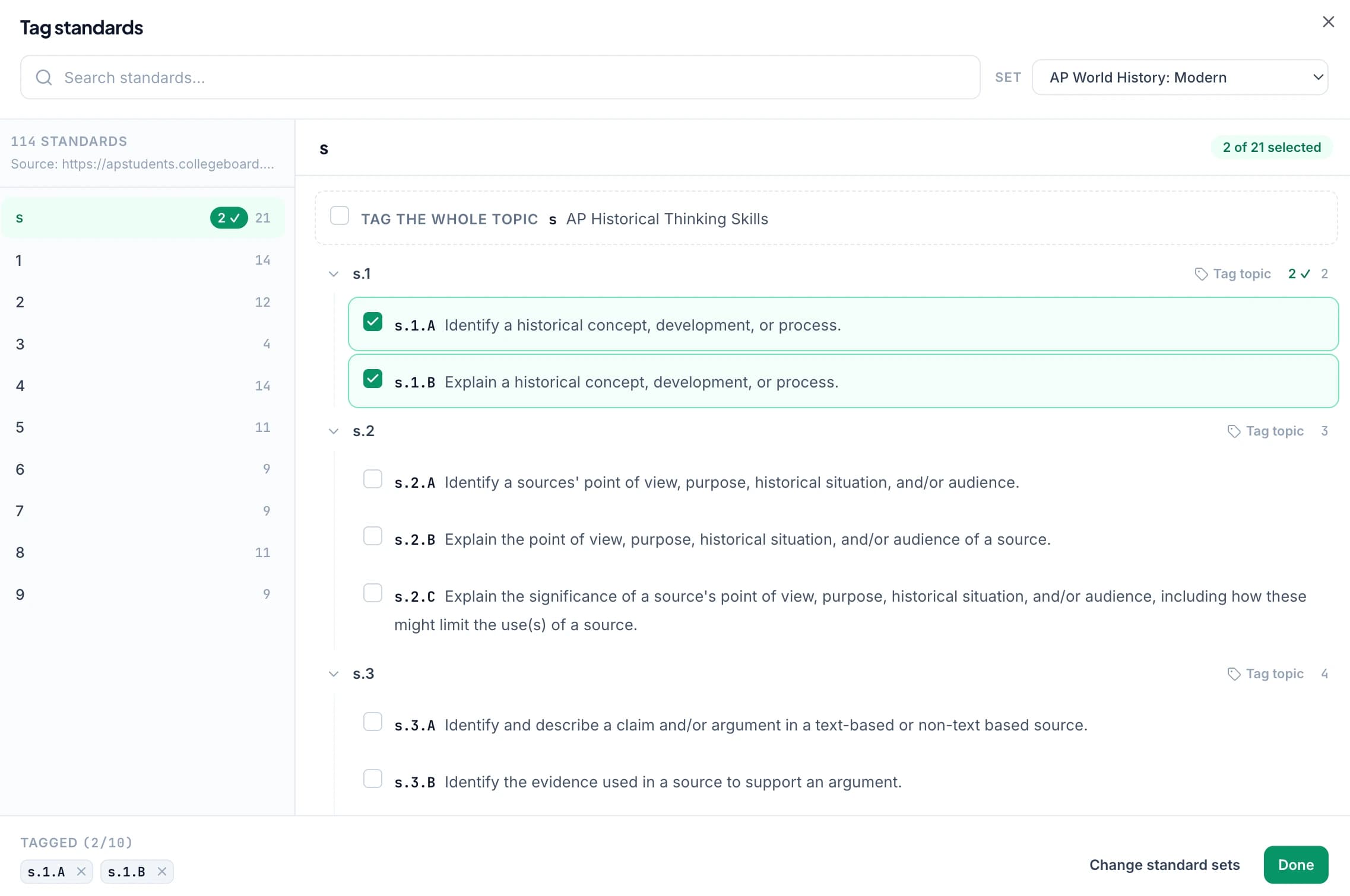
Choose the framework that fits your class
Start with the course, state, or framework your school uses. Select the available grade and strand, then review whether the proposed tags match the criteria and assignments you teach.
Common Core
Connect ELA and math work to relevant grade-level expectations. Assess writing, reading responses, mathematical answers, and reasoning against your rubric. Common Core grading.
NGSS
Connect submitted science work to relevant performance expectations and the scientific ideas, practices, and crosscutting concepts the task assesses. NGSS science grading.
Texas TEKS and STAAR practice
Use TEKS-aligned classroom work across reading, writing, math, science, and other supported subjects. Inspect practice evidence and student feedback. Texas grading.
California and CAASPP practice
Assess source-based writing, mathematical reasoning, and science explanations using your classroom rubric and the appropriate California learning goals. California grading.
Florida B.E.S.T. and FAST context
Connect everyday ELA and math work to selected B.E.S.T. benchmarks. Keep Florida science aligned to its appropriate separate set. Florida grading.
New York NGLS and Regents practice
Assess department-designed writing, constructed responses, and other classroom practice, with the correct ELA, math, science, or social studies context. New York grading.
AP courses
Assess free-response practice in writing, history, math, and science against your teacher or department rubric. Review alignment to the relevant course objectives. AP practice grading.
IB courses
Use department criteria for appropriate practice and permitted draft feedback. Inspect the work and choose guidance that fits the component's requirements. IB coursework support.
GCSE, IGCSE, and A-level courses
Use your marking criteria for practice papers and extended responses associated with supported exam-board resources. Exam-board practice grading.
Find standards beyond the featured state pages
The four dedicated state pages are examples of detailed classroom workflows. GradingPal's state coverage extends across all 50 states and Washington, D.C. Select the actual set, subject, and version used by your school in the product.
Browse the full US state coverage
Alabama, Alaska, Arizona, Arkansas, California, Colorado, Connecticut, Delaware, Florida, Georgia, Hawaii, Idaho, Illinois, Indiana, Iowa, Kansas, Kentucky, Louisiana, Maine, Maryland, Massachusetts, Michigan, Minnesota, Mississippi, Missouri, Montana, Nebraska, Nevada, New Hampshire, New Jersey, New Mexico, New York, North Carolina, North Dakota, Ohio, Oklahoma, Oregon, Pennsylvania, Rhode Island, South Carolina, South Dakota, Tennessee, Texas, Utah, Vermont, Virginia, Washington, West Virginia, Wisconsin, Wyoming, and Washington, D.C.
A state name identifies where to look, not a claim that every course uses identical codes or versions. Check the selected standards set against the curriculum your class follows.
Review alignment at the question or rubric level
Choose the relevant sets for the class, then use GradingPal's suggested standards on questions or rubric criteria. Inspect the suggestion, confirm what evidence the task provides, and accept or dismiss the tag.
This makes the connection more specific than attaching a broad course label to the assignment. A criterion about explaining evidence should point to that learning goal, while a separate calculation criterion should reflect the mathematical demand being assessed.
Turn aligned work into useful student feedback
GradingPal assesses the submitted response against your rubric and writes individualized comments. Use the criteria and evidence to explain what the student demonstrated and the next improvement to make.
A standard code organizes the learning goal. The comment makes it actionable: explain why the quotation matters, justify the calculation step, or connect the conclusion to the data. Choose feedback settings that use the language taught in your class.
Build standards evidence as you approve assessments
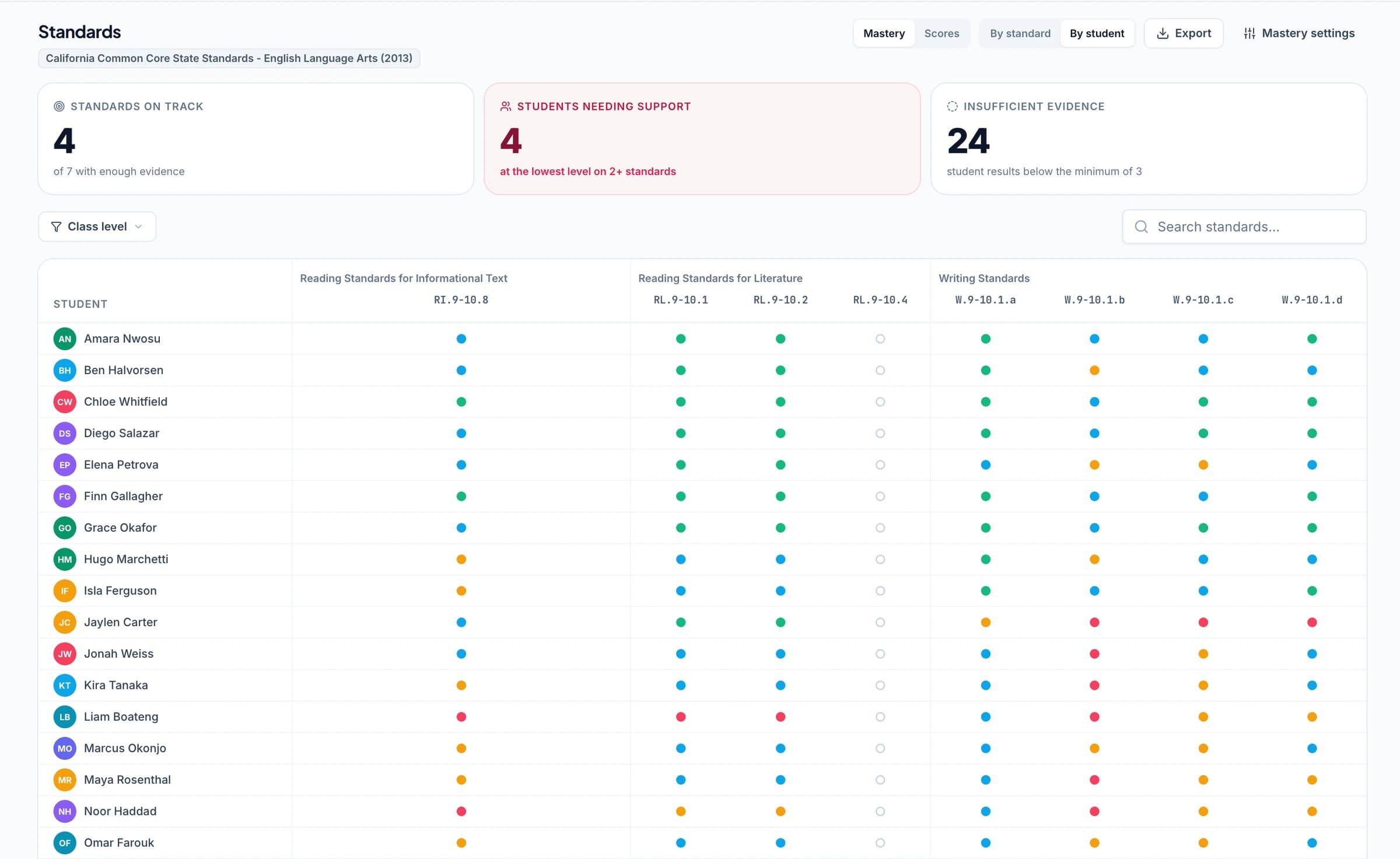
Approved results with accepted alignment contribute evidence to the relevant standards record. Open the underlying work when you need to explain a result or inspect a student's development across assignments.
The optional mastery gradebook combines evidence using your chosen method, scale, and weighting. Classroom analytics, on eligible plans, adds patterns and suggested instructional activities. Together, these views connect assessment to the next teaching decision.
Keep the assessment approach that fits your school
Standards tracking is optional. You can continue using assignment points and feedback, review standard-level percentages, or enable mastery levels when those fit your reporting approach.
Use the relevant rubric resources, review any existing alignment, and discuss shared expectations as a team. Framework support organizes classroom evidence; official examinations and awarding-body results remain separate processes.
Questions about supported standards
Can I use state standards outside Texas, California, Florida, and New York?
Yes. Coverage includes all 50 states and Washington, D.C. Select the available subject and version for your class; the featured state pages provide deeper examples rather than the full extent of coverage.
Can I use more than one standards set in a class?
The class setup supports up to five selected sets. Choose the relevant frameworks, grades, and strands, then review the alignment suggested for the actual tasks.
Does GradingPal automatically accept suggested tags?
No. Review and accept the suggestions that match the assignment. Alignment becomes useful when the criterion actually assesses the selected learning goal.
Do tags change the rubric's point values?
Standards tags connect criteria to learning goals. Your rubric defines the scoring criteria and points; the mastery view organizes approved aligned results using its separate calculation settings.
Are AP, IB, and exam-board resources official scoring services?
No. These workflows support teacher-led classroom practice and the relevant course context. They do not provide official examination scoring, grade predictions, or awarding-body endorsement.
Do I have to use mastery levels?
No. Standards tracking and mastery levels are optional. You can retain assignment points and percentages and choose the additional evidence views appropriate to your practice.
Can I bring aligned rubric resources into a teaching team?
Use the library and shared-resource options included in your plan. Review the criteria and tags together so the resource fits the assignments and standards your team actually uses.
Does classroom practice predict a state or external exam score?
No. The evidence describes the submitted work assessed under your criteria. It supports classroom planning and feedback, not an official test result or grade prediction.
Are official scoring rubrics included for every framework?
A framework name is not a promise of official scoring materials. Inspect the actual rubric resource available and use your teacher or department criteria where appropriate. Explore rubric options.
Explore related features
- How AI grading works
- Classroom analytics
- Read the California standards and CAASPP guide
- Read the Common Core guide
- Read the Florida B.E.S.T. and FAST guide
- Read the rubric alignment guide
- Read the New York standards and Regents guide
- Read the NGSS guide
- Read the Texas TEKS and STAAR guide
- See GradingPal in action
- All GradingPal features
- GradingPal for schools
- Free AI grading
- Rubric library
- Standards based grading
- Standards mastery gradebook
- AP practice grading
- Standards / california caaspp
- Standards / common core
- Standards / exam boards
- Standards / florida best fast
- IB coursework support
- Standards / new york regents ngls
- NGSS science grading
- Standards / texas staar teks
- GradingPal for UK teachers
Learn more on the blog
- Common Core Standards: The Complete 2026 Guide for K-12 Teachers - History, Implementation, Benefits, Challenges, Alignment & Best Practices
- NGSS Standards: The Complete 2026 Guide for K-12 Teachers - Three Dimensions, Performance Expectations, Implementation, Benefits, Challenges & Best Practices
- Standards-Based Grading: The Complete 2026 Guide for K-12 Teachers - Benefits, Implementation, Rubrics, Common Core, State Standards & Best Practices
Start with a learning goal your next assignment assesses
Select the framework, review the relevant rubric tags, and see how approved work builds an evidence record you can use in teaching.