AI grading for Common Core writing and math
Use GradingPal to assess ELA and math work against your rubric, connect relevant criteria to Common Core goals, and give students feedback they can act on. Approved aligned results build an evidence record across assignments, so the next teaching decision can use more than the assignment total.
Assess the skills within the response
A writing task can show evidence selection, reasoning, and organization. A math response can show an answer, a method, and an explanation. Put the assessed expectations into distinct rubric criteria so GradingPal can generate scores and comments that explain those differences.
Review the student response and criterion-level evidence before approving. The rubric defines what earns credit; the selected Common Core tags connect those results to the learning goals your class is working toward.
Grade ELA and math assignments you already teach
Choose the supported grader that fits the response, and use the task's actual criteria rather than a generic writing score.
Argument and evidence-based writing
Assess the claim, supporting evidence, and explanation. Give feedback on the connection a student needs to develop rather than only asking for “more detail.” Explore essay grading.
Informative and narrative writing
Use criteria that reflect the purpose of the task, its development, and organization. GradingPal writes comments about the submitted response under those expectations.
Reading responses and text analysis
Assess the explanation and textual evidence students provide. Keep the source context and task requirements available when reviewing the proposed assessment.
Math answers and handwritten working
Assess supported calculations and reasoning against course criteria. Specify method and partial-credit expectations, and review the steps shown by the student. Explore math grading.
Connect each criterion to the relevant Common Core goal
Select the appropriate Common Core set for the class, then inspect suggested tags on questions or rubric criteria. Use the available level of detail that matches what the task assesses and accept the relevant suggestions.
For ELA, that can distinguish a writing expectation from a reading response. For math, select the relevant grade or content domain and review the relationship between the task and the standard. If your state uses a modified set, select the version your school actually follows.
Turn an evidence criterion into a revision action
Consider an illustrative argument response: the student selects a relevant quotation but does not explain how it supports the claim. GradingPal assesses that response against your rubric and drafts feedback about the missing explanation.
Review the suggested score, then ask the student to add the link between evidence and claim. The aligned criterion identifies the learning goal; the individual comment makes the next action clear in the student's own paragraph. Explore feedback controls.
See what needs reteaching across the class
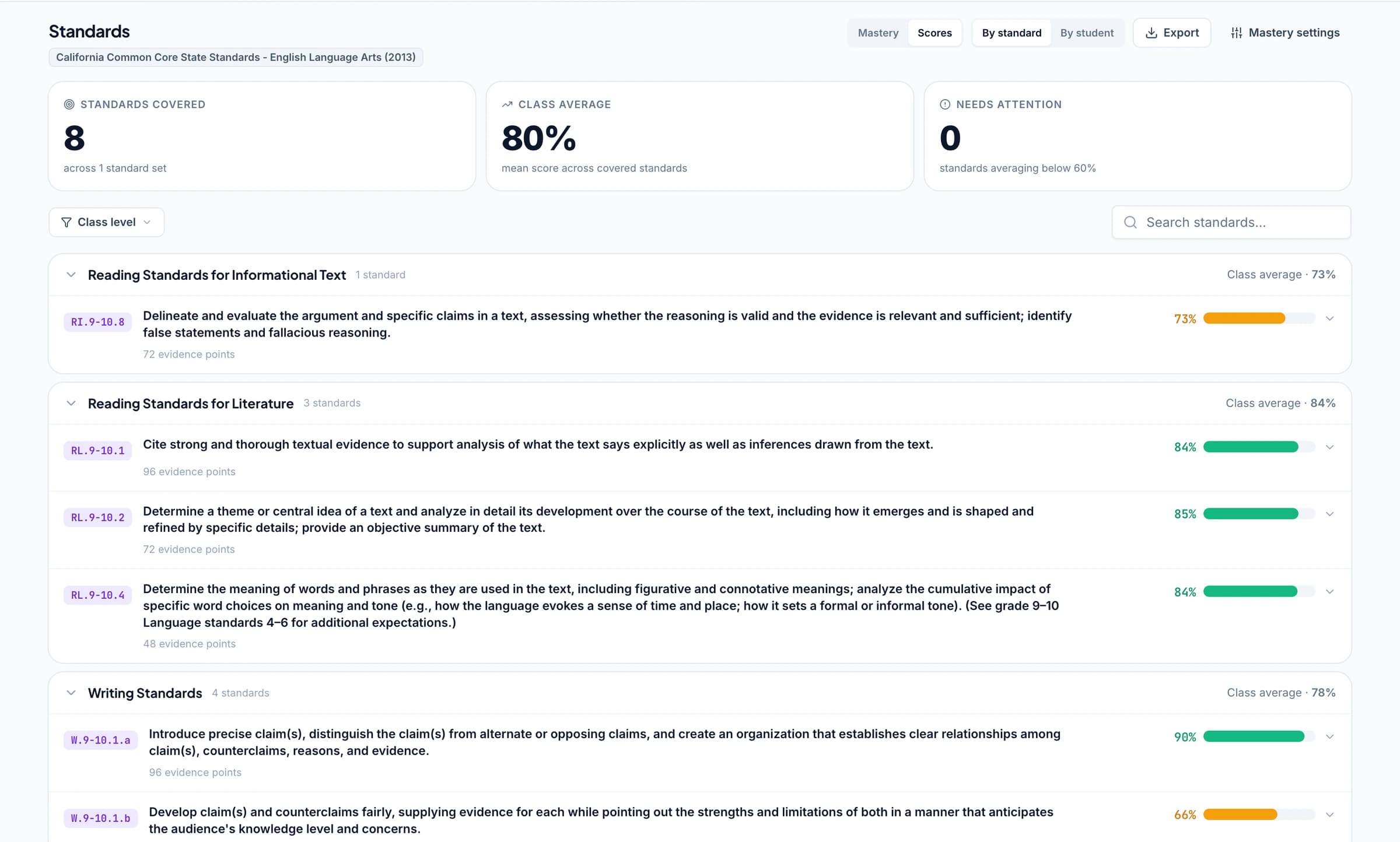
On plans with performance analytics, inspect recurring strengths, difficulties, and associated student responses. If many students have the same evidence-to-explanation gap, use a shared example in the next lesson; if a smaller group needs support, plan a focused task.
For math, review whether the difficulty is the method, the calculation, or the explanation the question asks for. These are illustrative teaching decisions, chosen after inspecting the actual assessment evidence.
Track the same goal across later assignments
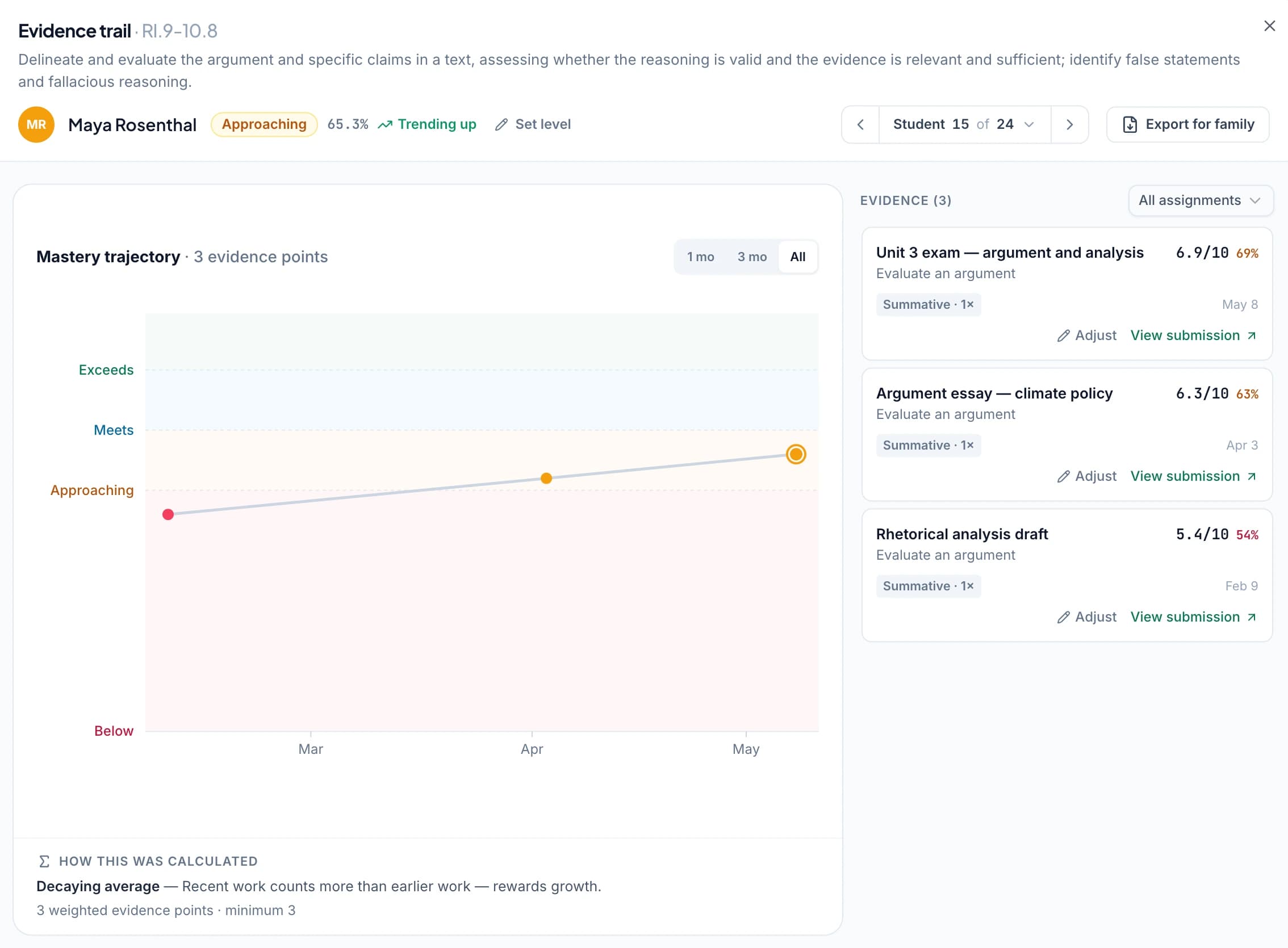
The optional standards mastery gradebook brings approved aligned results together across tasks. Open the evidence contributing to a standard and compare the student's responses over time.
Use your selected calculation settings if you enable mastery levels. Assignment points and percentages remain available, so Common Core evidence tracking can sit alongside your current grading approach rather than requiring an immediate reporting change.
Questions about Common Core grading
Can I tag a specific part of a standard?
Use the available level of detail in the selected set and review whether the criterion provides evidence of that expectation. Accept the alignment that matches the assignment.
What if my state uses an adapted version?
Choose the set your school or district actually uses. A Common Core label does not mean every local code, wording, or version is identical.
Does GradingPal certify that a task is aligned?
You review the task, rubric, and tags. GradingPal records the alignment you approve and organizes the resulting evidence; it does not certify curriculum alignment.
Does this support math as well as writing?
Yes. Use supported mathematical responses and readable handwritten working with criteria for answers, methods, and reasoning. Review the score evidence before approving the assessment.
Can I keep normal assignment grades?
Yes. Standards tracking is optional and can sit alongside points and percentages. Mastery levels are a separate choice under your selected settings.
Does classroom evidence predict a state-test result?
No. The results describe the work you assessed under your rubric. They are useful for feedback and teaching decisions, not official test scoring or prediction.
Learn more on the blog
- Common Core Standards: The Complete 2026 Guide for K-12 Teachers - History, Implementation, Benefits, Challenges, Alignment & Best Practices
- How to Align Rubrics to Standards: A Practical Guide for Common Core, NGSS, TEKS & State Standards (2026)
- High School Argumentative Writing Rubrics: Examples and Best Practices
Give the next ELA or math assignment a clearer feedback purpose
Choose the relevant goal, review the rubric alignment, and return a next step students can apply to their work.