AI science grading aligned with the NGSS goals you teach
GradingPal assesses submitted science explanations, investigations, and data responses against your rubric. Connect relevant criteria to NGSS expectations, give students specific feedback, and use approved evidence to see which ideas and reasoning need more teaching.
50 free submissions per month, shared across assignment types.
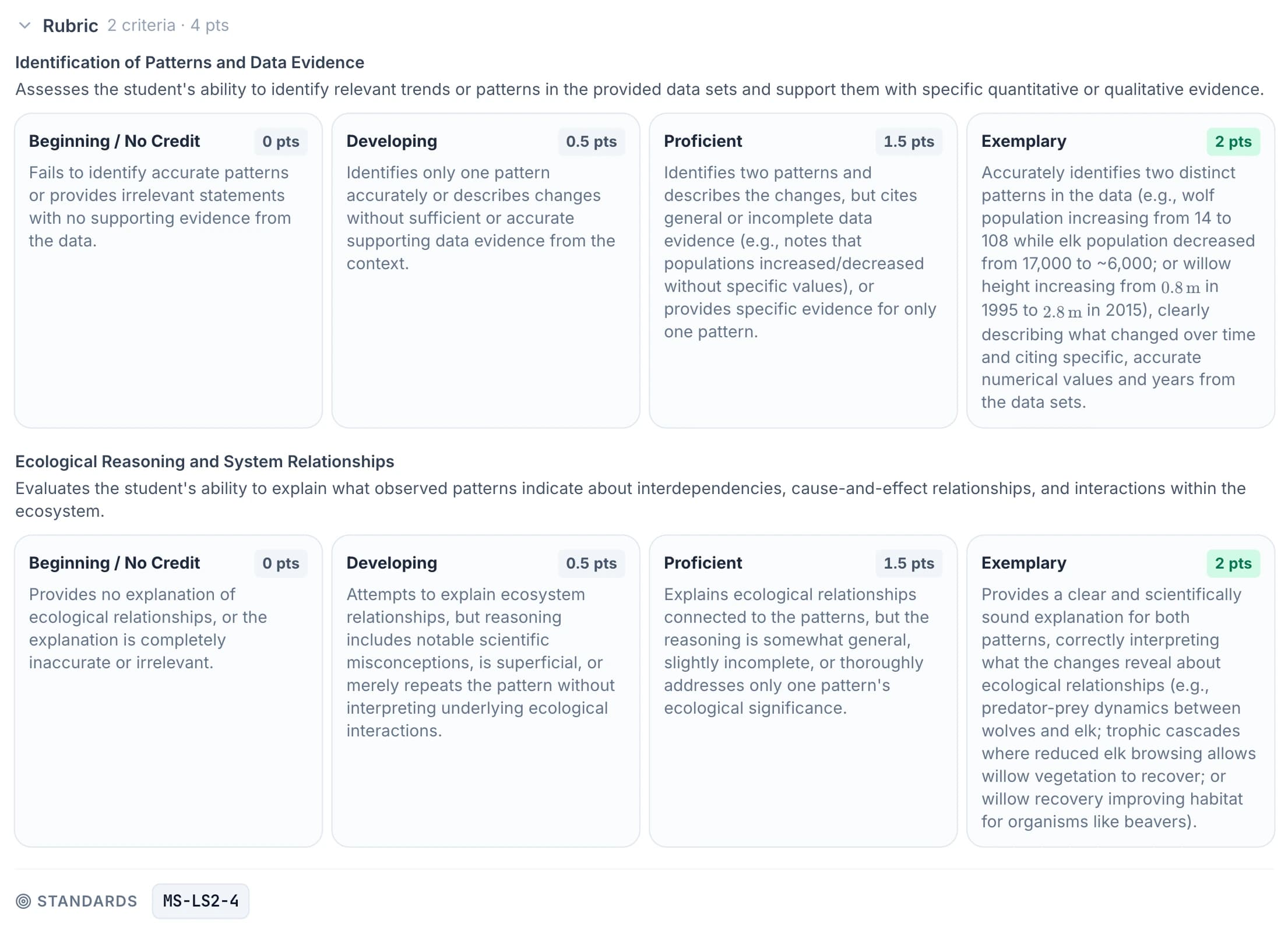
Assess scientific reasoning as well as the answer
Students can name a concept without explaining how it applies to the evidence. Use separate criteria for the knowledge, practice, and reasoning the task asks students to demonstrate. GradingPal generates suggested scores and comments against those expectations.
Inspect the response and the explanation behind each score. Check the science and the assignment context, then return feedback that helps the student improve the submitted explanation, analysis, or conclusion.
Use the science assignments that reveal learning
GradingPal supports scientific writing and quantitative responses across relevant assessment formats. Choose the task and rubric that make the expected evidence explicit.
Life science
Assess explanations and investigations involving biology, including how students use results to support a conclusion. Review the reasoning in the submitted response, not only the presence of the correct term.
Physical science
Assess calculations, methods, and explanations in physics and chemistry. Readable handwritten working can show how the student reached the answer and where the method needs correction.
Earth and space science
Assess interpretation of data, patterns, and systems in written responses. Use criteria that require the student to explain the relationship the task is investigating.
Engineering design
Assess the documented response to criteria and constraints, including the reasoning students provide for design choices and evaluation. Use classroom observations separately where the submitted material does not show practical performance.
Connect the rubric to relevant NGSS dimensions
Select the appropriate NGSS set and review suggested alignment for each relevant question or criterion. An assignment may involve a disciplinary core idea, a science and engineering practice, and a crosscutting concept; keep the assessed expectations clear in your rubric.
Accept the available tags that match the evidence the task provides. A framework label alone does not establish that a response demonstrates every dimension of a performance expectation. Explore the standards workflow.
Give students a concrete way to strengthen an explanation
In an illustrative investigation, a student identifies a trend but does not explain how the results support the conclusion. GradingPal assesses the response against your explanation criterion and drafts feedback about the missing connection.
Review the comment and ask the student to name the relevant results, explain the relationship, and connect it to the scientific idea. This gives the student a task they can complete in the report instead of a broad instruction to “improve the reasoning.” Customize feedback.
Identify which science concepts need another model
With paid classroom analytics, inspect patterns across approved responses and the students associated with them. A recurring gap in interpreting data may call for a worked example; a smaller group may need practice distinguishing an observation from an explanation.
Check the supporting work before choosing the response. The useful outcome is a teaching decision based on the evidence, with an activity that targets the particular difficulty your students have shown.
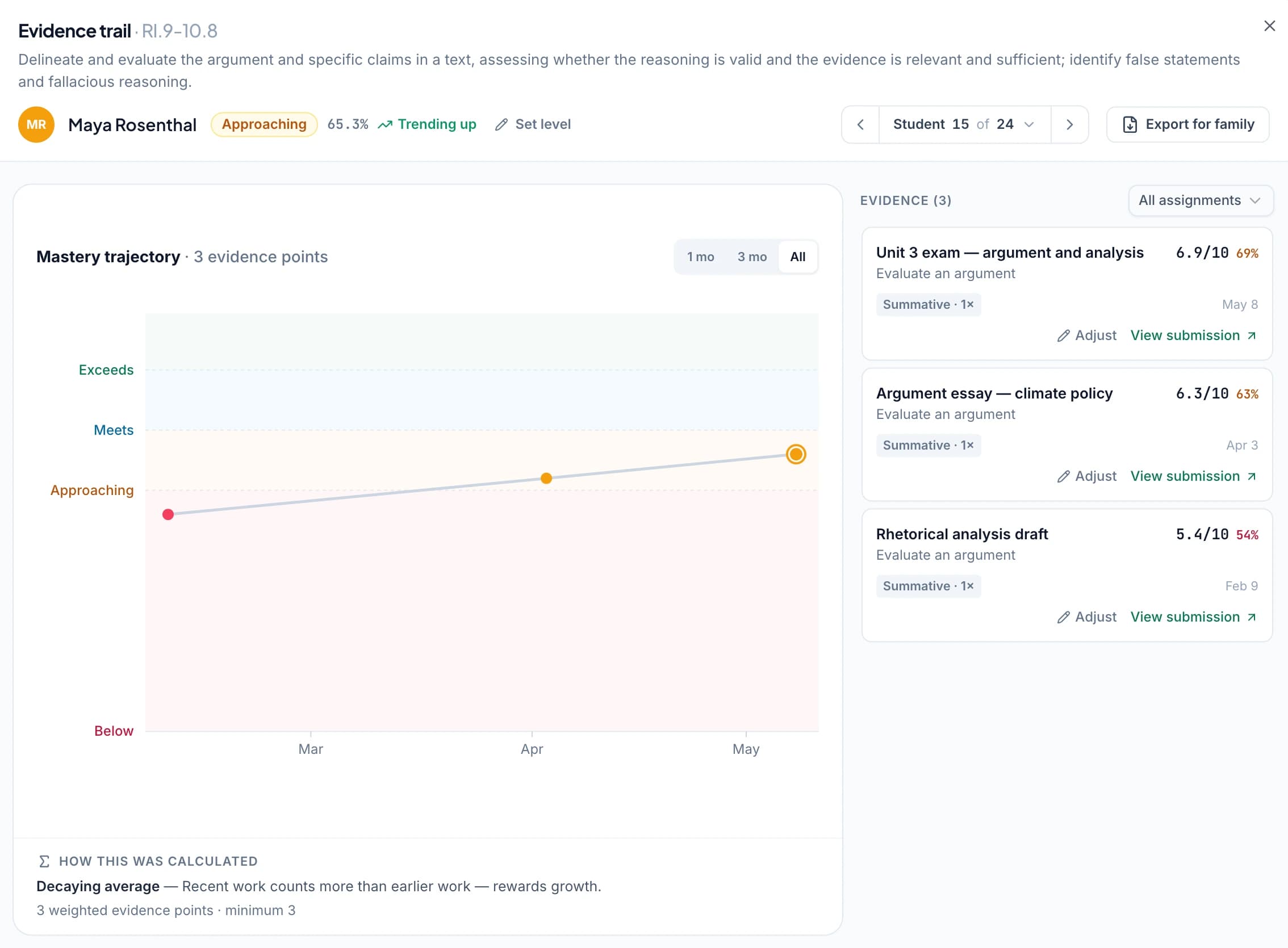
Follow a practice across different science tasks
Use the optional standards mastery gradebook to inspect approved aligned evidence across an investigation, a shorter explanation, and a later assessment. Open the underlying work to see what the student demonstrated in each context.
Choose the calculation settings if you enable mastery levels. Keep assignment points and percentages where appropriate, and use the evidence record to plan the next opportunity to demonstrate the learning goal.
Questions about NGSS-aligned grading
Can I connect different NGSS dimensions separately?
Use the available standards structure and relevant rubric criteria, then review each proposed alignment. The task must provide evidence of the expectation you tag.
Does GradingPal guarantee that every scientific claim is correct?
GradingPal assesses the submitted work against your rubric and provides scoring explanations for review. Check scientific correctness and context; the workflow does not guarantee independent verification of every claim or cited source.
Can it know what happened during the practical?
It assesses the evidence submitted. Use your observations and other classroom evidence for practical behaviors or events the report does not establish.
Can I assess handwritten calculations?
Yes. Use readable supported math and science working, specify the method and answer criteria, and inspect any unclear interpretation before approving the result.
Can feedback guide claim-evidence-reasoning work?
Yes. Express the relevant expectations in the rubric and add the classroom terminology in feedback instructions. Review the comment so it identifies a specific improvement in the student's explanation.
Is this the same as Florida's NGSSS?
No. Select the framework used by your class. See the Florida page for its separate science context rather than treating similarly named sets as interchangeable.
Learn more on the blog
- NGSS Standards: The Complete 2026 Guide for K-12 Teachers - Three Dimensions, Performance Expectations, Implementation, Benefits, Challenges & Best Practices
- Effective Rubrics for Middle School Science Labs and Experiments: The Complete 2026 Guide
- Grading STEM Projects: Best Practices for K-12 Teachers
Make the next science response easier to teach from
Assess the explanation, return a specific next step, and use the evidence to plan the next model or investigation.